
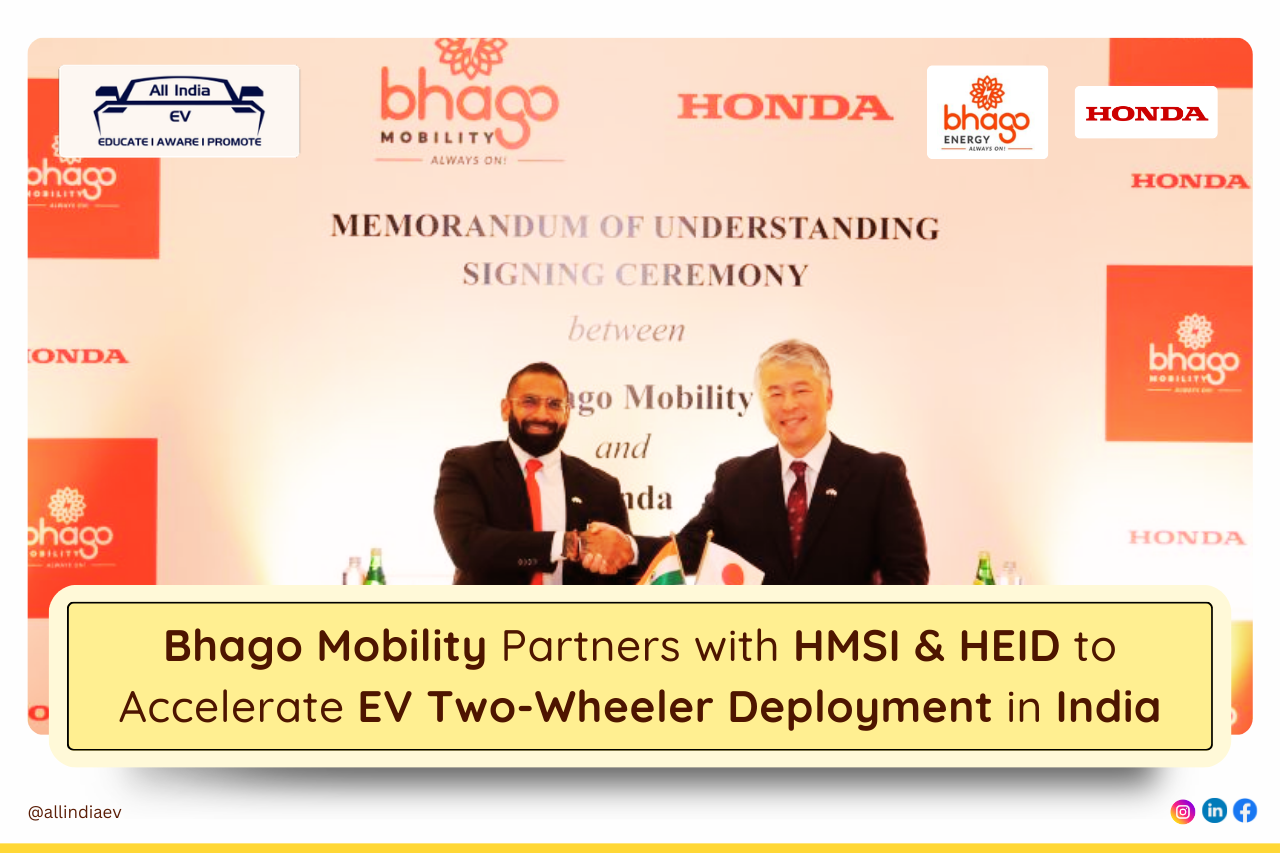

Combines OEM manufacturing, fleet deployment, and on-ground financing to accelerate commercial EV adoption
India’s electric two-wheeler market is shifting from retail hype to operational scale, especially in last-mile delivery and shared mobility. This JV exists to solve a very practical bottleneck: aligning vehicle supply, financing, and fleet operations so deployments can move from pilots to repeatable, city-by-city rollouts.
Deal Facts
- Partners: Bhago Mobility (EV fleet and mobility platform), Honda Motorcycle & Scooter India (HMSI), and Heid (mobility financing/solutions).
- Scope: Expand electric two-wheeler deployment across commercial use cases, including delivery and fleet operations.
- Geography: India (specific cities/regions Not disclosed — matters because unit economics and charging access vary widely by state and city).
- Timeline: Phased rollout planned in 2026 (specific milestones Not disclosed — matters for assessing execution pace and capital intensity).
- Investment size: Not disclosed — matters to gauge seriousness of scale vs. pilot optics.
- Ownership structure of JV: Not disclosed — matters for governance, control over pricing, and IP/data rights.
- What’s being delivered: Electric two-wheelers integrated into fleet operations, with financing and operational support.
- Charging infrastructure commitments: Not disclosed — matters because vehicle deployment without reliable charging weakens utilization and ROI.
- Target volumes: Not disclosed — matters to evaluate whether this is a meaningful market intervention or a symbolic partnership.
What Each Partner Brings
Bhago Mobility
- Fleet operations, last-mile deployment experience, and demand aggregation across delivery/logistics clients.
- Data on utilization, rider behaviour, maintenance cycles, and real-world TCO across Indian operating conditions.
HMSI (Honda Motorcycle & Scooter India)
- Manufacturing scale, supplier ecosystem, quality control, and aftersales service footprint across India.
- Brand trust with fleet operators and financiers, lowering perceived technology and residual-value risk.
Heid
More EV News
- Financing structures for fleet buyers/operators, potentially including leasing, pay-per-use, or asset-light models.
- Risk assessment frameworks for EV assets, which is still underdeveloped in India’s NBFC ecosystem.
The Operating Model (how this could actually work in India)
At its best, this JV functions less like a traditional OEM partnership and more like a deployment engine. HMSI supplies standardized electric two-wheelers that are pre-configured for commercial use—higher duty cycles, swappable components, predictable maintenance schedules. Bhago aggregates fleet demand from delivery platforms, gig operators, and potentially municipal or enterprise buyers. Heid underwrites asset risk and structures financing so operators avoid heavy upfront capex. The model works only if vehicles, financing, and fleet operations are contractually bundled into a single deployment offering rather than three loosely coordinated initiatives.
Operationally, India forces hard trade-offs. Fleet uptime matters more than spec-sheet range. Battery degradation in high-heat, high-load urban use will dictate replacement cycles and warranty terms. If charging is not co-developed—either via depot charging, battery swapping partnerships, or preferential access to public networks—the JV risks pushing assets into underutilization. The operating model needs a city-level playbook: demand density, charger access, maintenance turnaround SLAs, and financing terms calibrated per micro-market, not one national template.
Integration & Execution Risks
- Misaligned incentives: OEMs optimize for unit sales, fleets optimize for uptime and TCO; without shared KPIs, friction is inevitable.
- Financing risk models: If default and downtime risks are mispriced, Heid’s capital costs will rise, squeezing deployment velocity.
- After-sales bottlenecks: EV downtime from spares or service delays can collapse fleet economics faster than in ICE models.
- Charging dependency: Lack of dedicated charging or swapping agreements could cap daily utilization below break-even thresholds.
- Governance opacity: Undisclosed ownership and decision rights could slow pricing, product iteration, and city-level expansion.
Who Wins / Who Gets Squeezed
Who Wins
- Fleet-first EV operators: Those with dense urban routes and predictable duty cycles benefit from bundled vehicles + financing.
- OEMs with service depth: Manufacturers able to support high-uptime commercial use gain share over consumer-first EV brands.
Who Gets Squeezed
- Small, undercapitalized fleet operators: Without access to JV-backed financing, their cost of capital worsens.
- Independent EV assemblers: Lacking financing and service scale, they struggle to compete on TCO and reliability.
Next 90 Days: What to Track
- [OEM] First production-ready commercial EV SKU details (battery spec, warranty terms, service intervals).
- [CPO] Any charging partnerships announced to support depot or corridor-based operations.
- [Supplier] Battery sourcing strategy and localization commitments (cells, packs, BMS).
- [Fleet] Named anchor customers or pilot fleets with disclosed vehicle counts.
- [Investor] Capital commitment or financing pool size from Heid to underwrite deployments.
- [Policy] State-level incentives or fleet EV procurement programs aligned with this rollout.
Conversation Starters
- Will fleet-grade EV two-wheelers converge to a standardized spec across OEMs, or remain fragmented by platform?
- Can financing innovation move the needle faster than battery cost declines in improving fleet TCO?
- Is India ready for city-level EV fleet playbooks, or will deployments remain pilot-heavy for another cycle?