
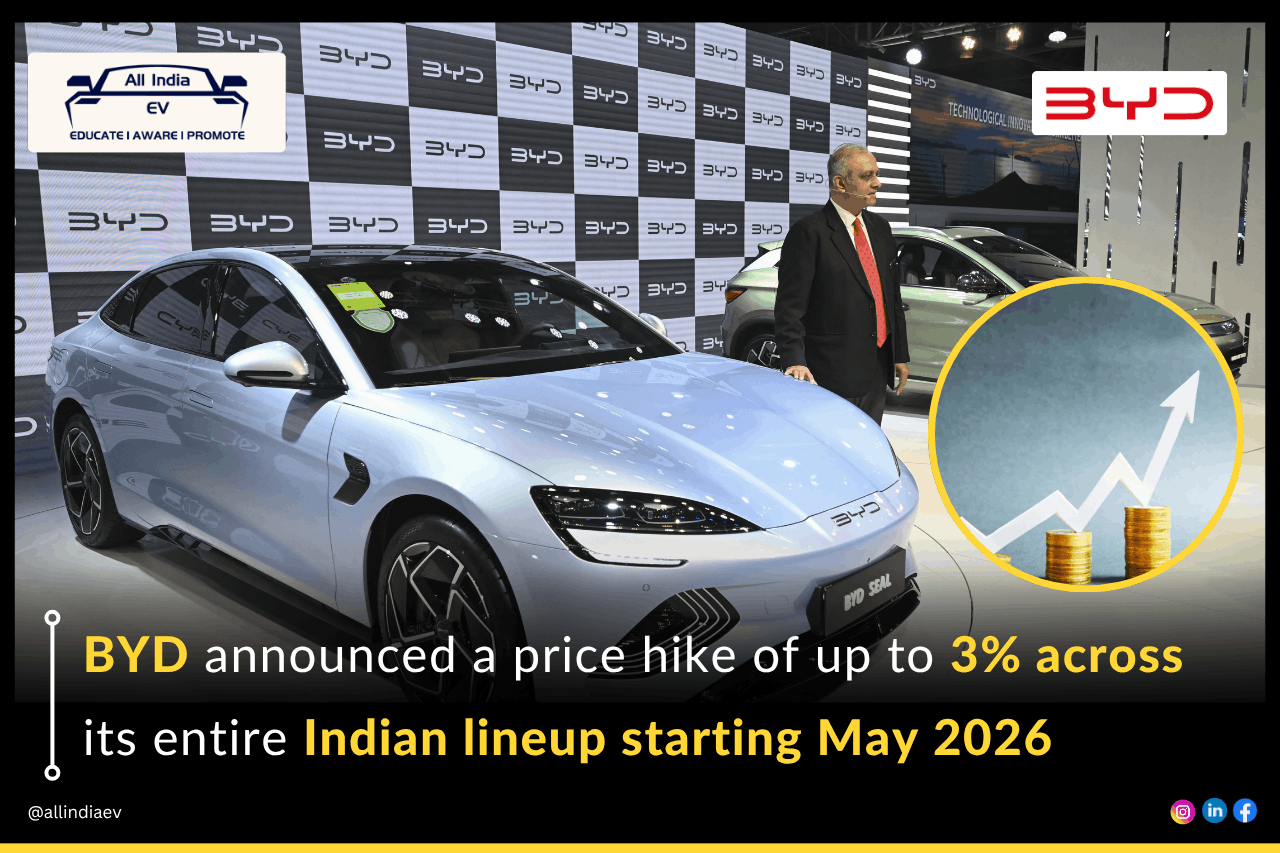

What: BYD will implement a price hike across its entire EV lineup in India starting May 1, 2026.
The Number:2–3% increase, translating to roughly ₹50,000 to ₹1.7 lakh depending on model and variant.
The Impact: The move raises entry barriers for premium EV buyers and signals ongoing cost pressure across the EV supply chain.

The Core News
The BYD India price hike May 2026 marks a full-portfolio revision, with all four models, Atto 3, eMax 7, Seal, and Sealion 7, set to become more expensive from May. This is the first time in 2026 that the company is increasing prices across its entire lineup, reflecting sustained cost pressures rather than model-specific adjustments.
The primary trigger behind the price increase is rising global input costs, particularly for EV battery materials such as aluminium and petroleum coke. These materials are critical to battery production, which itself accounts for a significant portion of EV manufacturing costs. Disruptions in global logistics—especially around the Strait of Hormuz, have further escalated shipping and import expenses.
This development is not isolated. The Indian automotive market is witnessing a broader pricing reset, with multiple OEMs adjusting prices to protect margins amid volatile global supply chains. BYD’s decision underlines the vulnerability of import-dependent EV models in India and highlights the ongoing challenge of cost stability in a rapidly scaling EV ecosystem.
More EV News

Breaking Down the Update
• Price increase applicable from May 1, 2026
• Covers entire BYD India portfolio (Atto 3, Seal, eMax 7, Sealion 7)
• Increase range: ₹50,000 to ₹1.7 lakh depending on variant
• Driven by rising raw material and logistics costs
• Linked to geopolitical disruptions affecting global supply chains
• Second price adjustment by BYD in 2026
How BYD India price hike May 2026 will help Indian EV Market
While the BYD India price hike May 2026 may appear negative for consumers in the short term, it reflects a deeper structural shift in India’s EV ecosystem. Pricing corrections driven by global supply constraints often push the market toward localisation and domestic value chain development.
Higher import costs can accelerate policy momentum around local manufacturing, battery production, and component sourcing. For India, where EV adoption is still in a growth phase, such price pressures could indirectly support domestic OEMs with stronger localisation strategies.
Additionally, premium EV pricing adjustments can rebalance demand across segments. Buyers may increasingly explore mid-range EV options or locally manufactured alternatives, strengthening competition and diversification in the market.
From an industry standpoint, these price hikes also signal a move toward more realistic pricing models, where manufacturers pass on at least part of the cost burden instead of absorbing it entirely. This is critical for long-term sustainability, especially in a capital-intensive sector like EVs.
In effect, while the immediate impact may be slower demand in the premium segment, the broader outcome could be a more resilient and locally anchored EV ecosystem in India.
way froward..
The BYD India price hike May 2026 highlights the growing influence of global supply chain volatility on India’s EV pricing landscape. Going forward, the key variables to watch will be localisation strategies, battery cost trends, and geopolitical stability. If cost pressures persist, more OEMs are likely to follow similar pricing actions, reshaping EV affordability and competitive dynamics in the Indian market.
Read More: Catch up on All India EV’s related coverage on India’s evolving commercial EV subsidies and battery swapping policies at All India EV