
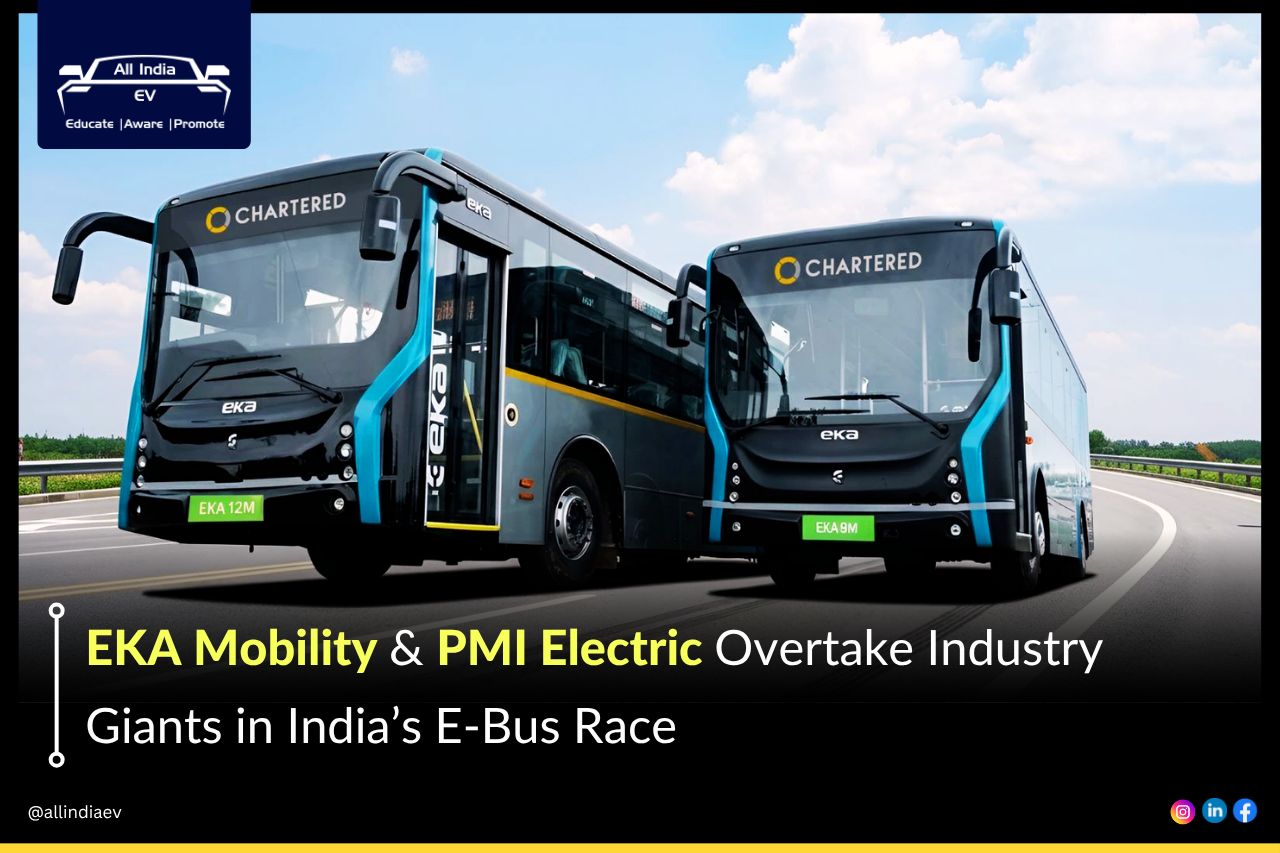

What: Indian electric bus makers EKA Mobility and PMI Electro Mobility have secured the majority share of CESL’s latest 6,230 electric bus tender, overtaking established commercial vehicle giants including Tata Motors and Ashok Leyland once again.
The Number: EKA Mobility reportedly secured 3,981 e-buses, PMI Electro Mobility won 500 units, while Tata Motors managed 200 buses. Ashok Leyland and VE Commercial Vehicles did not secure allocations in the latest tender round.
The Impact: The latest result indicates a structural shift in India’s electric bus market, where specialized EV-focused manufacturers are increasingly outperforming legacy commercial vehicle OEMs in large-scale public transport electrification projects.

The Core News
The latest CESL-backed procurement round has further strengthened the dominance of emerging electric mobility companies in India’s public transport electrification push. In the newest 6,230-unit tender, EKA Mobility and PMI Electro Mobility collectively secured more than two-thirds of the awarded electric buses, continuing a trend already visible in earlier PM E-drive, linked procurement cycles.
The development is particularly significant because legacy commercial vehicle manufacturers such as Tata Motors and Ashok Leyland have historically dominated India’s bus market. However, the rapid expansion of gross cost contract (GCC)-based electric bus tenders appears to be favoring companies built specifically around EV-focused business models, flexible production strategies, and aggressive bid pricing.
The tender also reflects the growing importance of operational economics in India’s electric bus ecosystem. Under CESL’s procurement structure, operators are responsible not only for supplying buses but also for maintaining charging infrastructure and fleet operations over long concession periods. This has intensified pricing competition and shifted focus toward battery efficiency, energy management systems, and lifecycle operating costs rather than only vehicle manufacturing scale.
More EV News
Breaking Down the Update
• EKA Mobility secured bids for 3,981 electric buses in the latest CESL tender
• PMI Electro Mobility won bids for 500 electric buses
• JBM Auto secured 899 buses in the same procurement cycle
• Tata Motors reportedly received allocation for 200 buses only
• Ashok Leyland and VE Commercial Vehicles failed to secure orders
• The tender size stood at 6,230 electric buses
• The procurement is linked to India’s broader PM eDRIVE public transport electrification strategy
• GCC-based operating models are becoming the dominant structure for public e-bus deployment
• Specialized EV manufacturers are increasingly outperforming traditional diesel bus OEMs in competitive bidding
• Similar trends were visible earlier in the 10,900-bus PM eDRIVE tender cycle
How electric bus tender will help Indian EV Market
The latest electric bus tender outcomes could significantly reshape India’s EV manufacturing and public mobility ecosystem over the next few years. Large-scale government-backed tenders are creating sustained demand visibility for electric bus manufacturers, battery suppliers, charging infrastructure companies, and fleet operators. This demand pipeline is critical for scaling domestic EV production capacity and reducing overall manufacturing costs.
The growing success of companies like EKA Mobility and PMI Electro Mobility also signals that India’s EV transition is opening space for newer specialized manufacturers rather than remaining concentrated among legacy automotive players. This increases competition, accelerates product innovation, and pushes manufacturers toward better fleet efficiency and lower operating costs.
Another major impact lies in charging infrastructure expansion. GCC-based tenders require operators to deploy and manage depot charging systems, energy optimization tools, and long-term maintenance operations. This creates downstream opportunities for energy management companies, battery technology firms, and charging solution providers.
The tender structure additionally supports localized manufacturing under India’s broader EV industrial strategy. Higher electric bus deployment can stimulate domestic battery assembly, component sourcing, software integration, and fleet analytics development. Over time, electric public transport adoption can also help reduce diesel dependence in urban mobility while improving city-level emissions and operating economics for state transport undertakings.
Way Forward ..
The latest electric bus tender results suggest that India’s public transport electrification market is entering a more competitive and execution-driven phase. While traditional OEMs still possess manufacturing scale and dealer networks, newer EV-first companies are currently demonstrating stronger positioning in aggressive government procurement cycles. The next key challenge will be execution quality, charging infrastructure deployment, fleet uptime performance, and long-term financial sustainability across these large electric bus contracts.
Read More: Catch up on All India EV’s related coverage on India’s evolving commercial EV subsidies and battery swapping policies at All India EV