
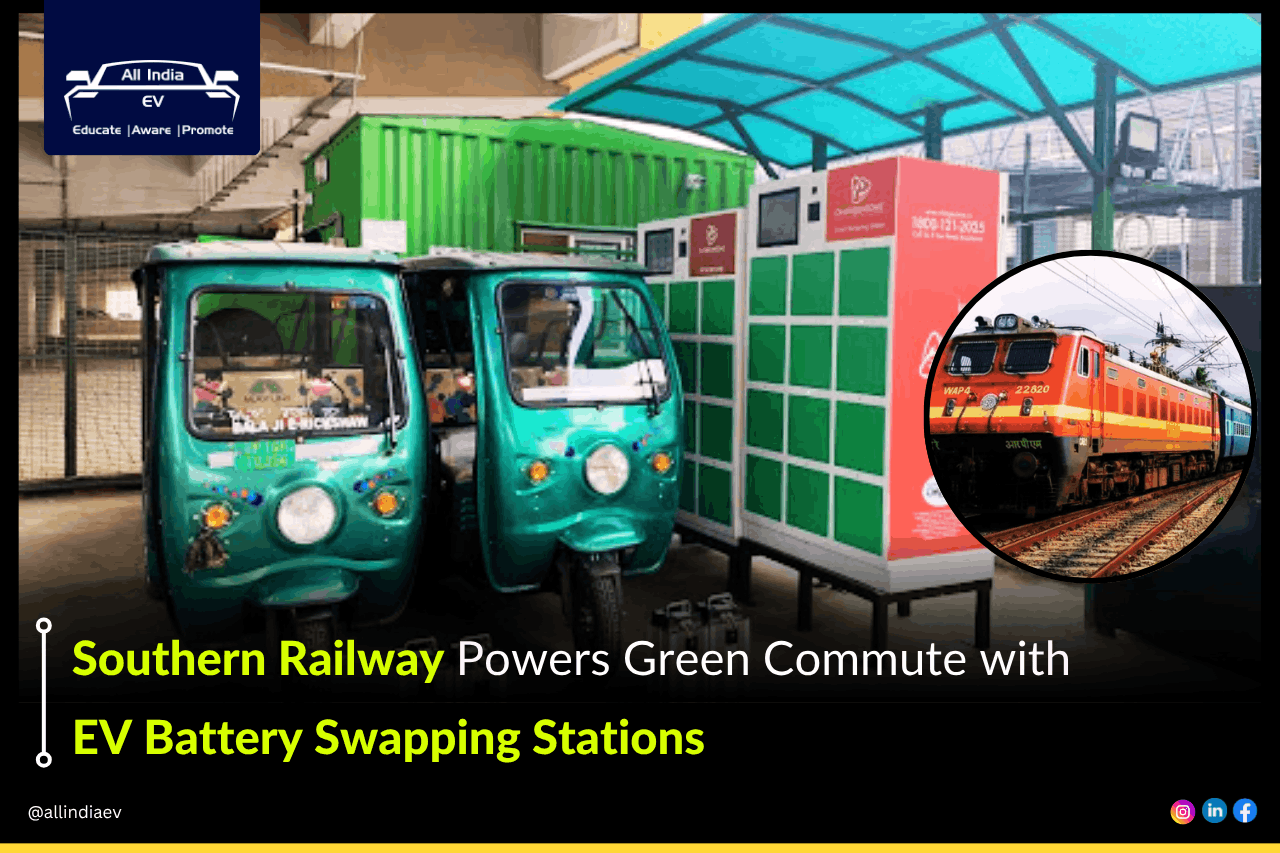

What: What : Southern Railway has started deploying EV battery swapping stations across Chennai’s suburban railway network to support faster electric mobility access and improve last-mile transportation connectivity.
The Number: A total of 21 contracts have been awarded for five years to establish swapping facilities across key suburban and MRTS railway stations in Chennai. The initiative is expected to generate annual licence fee revenue of around ₹53.43 lakh.
The Impact: The rollout strengthens public transport-linked EV infrastructure and signals how railway stations are increasingly becoming strategic hubs for urban electric mobility ecosystems in India.

The Core News
The deployment of the EV battery swapping stations by Southern Railway marks another step in integrating electric mobility infrastructure with India’s public transport network. Chennai Division has begun rolling out battery swapping facilities across suburban and MRTS railway stations, targeting commuters, delivery operators, students, and daily EV users who rely on fast turnaround times for mobility.
Unlike conventional charging infrastructure that requires vehicles to remain stationary for extended durations, battery swapping allows users to exchange depleted batteries for fully charged units within minutes. The facilities will operate through mobile app-based systems managed by authorised Charge Point Operators (CPOs). Railway authorities stated that the stations require limited space and are designed to avoid disruption to passenger movement within station premises.
The project also reflects a wider national trend where railway infrastructure is increasingly being used to support clean mobility deployment. Similar battery swapping initiatives are already being explored in Hyderabad, Secunderabad, and Bengaluru railway divisions in partnership with private energy infrastructure operators. This approach creates high-footfall EV service corridors while helping Indian Railways generate non-fare revenue streams from station assets.
More EV News

Breaking Down the Update
• Southern Railway is deploying battery swapping stations across Chennai suburban railway stations
• The initiative covers both suburban and MRTS corridors
• 21 contracts have been awarded under a five-year operating model
• Facilities will support electric two-wheelers and small mobility vehicles
• Users can swap depleted batteries within minutes through app-based systems
• Key stations include Chennai Central, Egmore, Velachery, Pallavaram, Saidapet, and Thiruvanmiyur
• The railway administration will provide station space while operators handle installation and maintenance
• The initiative is expected to create an additional non-fare revenue stream for Indian Railways
• Battery swapping reduces downtime compared to traditional EV charging systems
• The rollout aligns with India’s larger green mobility and urban decarbonisation targets
How EV battery swapping stations will help Indian EV Market
The expansion of EV battery swapping stations across railway networks can significantly improve the practicality of electric mobility in dense urban environments. One of the biggest operational challenges for electric two-wheelers and commercial delivery fleets is downtime caused by charging. Battery swapping directly addresses this issue by enabling near-instant energy replenishment without requiring long charging cycles.
For India’s urban mobility ecosystem, railway stations provide a strategic deployment opportunity because they already function as high-footfall transport hubs. Integrating swapping infrastructure at these locations can improve first-mile and last-mile connectivity while supporting gig economy riders, shared mobility operators, and urban commuters using electric vehicles daily.
The rollout of EV battery swapping stations can also reduce dependence on expensive large-format charging infrastructure in congested cities where land availability remains limited. Swapping systems require smaller footprints and can operate efficiently in compact transit locations. This makes them commercially attractive for transport-linked deployments.
From an industry perspective, the model supports Battery-as-a-Service (BaaS) adoption, lowers upfront EV ownership costs, and improves fleet utilisation rates. As more public infrastructure operators participate in EV ecosystem development, battery swapping could emerge as a critical component in India’s urban electrification strategy, especially for two-wheelers, three-wheelers, and delivery-focused mobility applications.
Way Forward ..
Southern Railway’s move highlights how public transport infrastructure is evolving beyond passenger movement into a broader urban mobility platform. The long-term success of these EV battery swapping stations will depend on interoperability standards, operator scalability, battery standardisation, and sustained user adoption. If executed efficiently, railway-linked swapping infrastructure could become a replicable model for EV mobility integration across other major Indian cities.
Read More: Catch up on All India EV’s related coverage on India’s evolving commercial EV subsidies and battery swapping policies at All India EV