

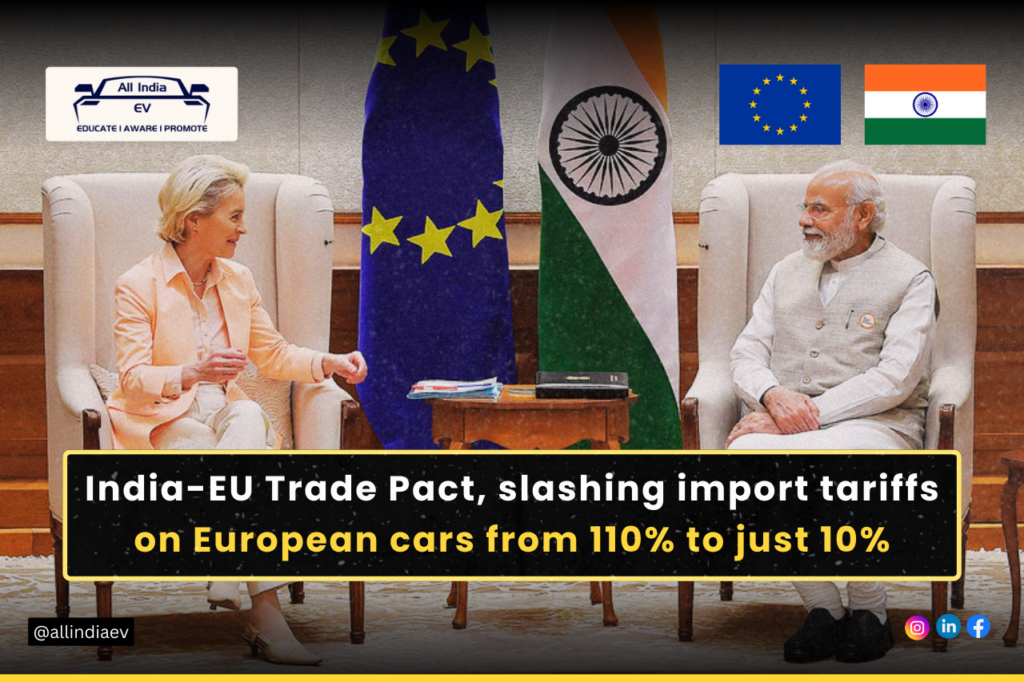
Lower tariffs may boost Europe’s luxury carmakers, but localisation norms and mass-market dynamics cap the wider impact, even as India’s auto components sector benefits.
India’s recently concluded free trade agreement (FTA) with the European Union promises to reshape automotive trade flows but industry experts warn that the gains may remain confined to premium carmakers rather than the broader domestic market.
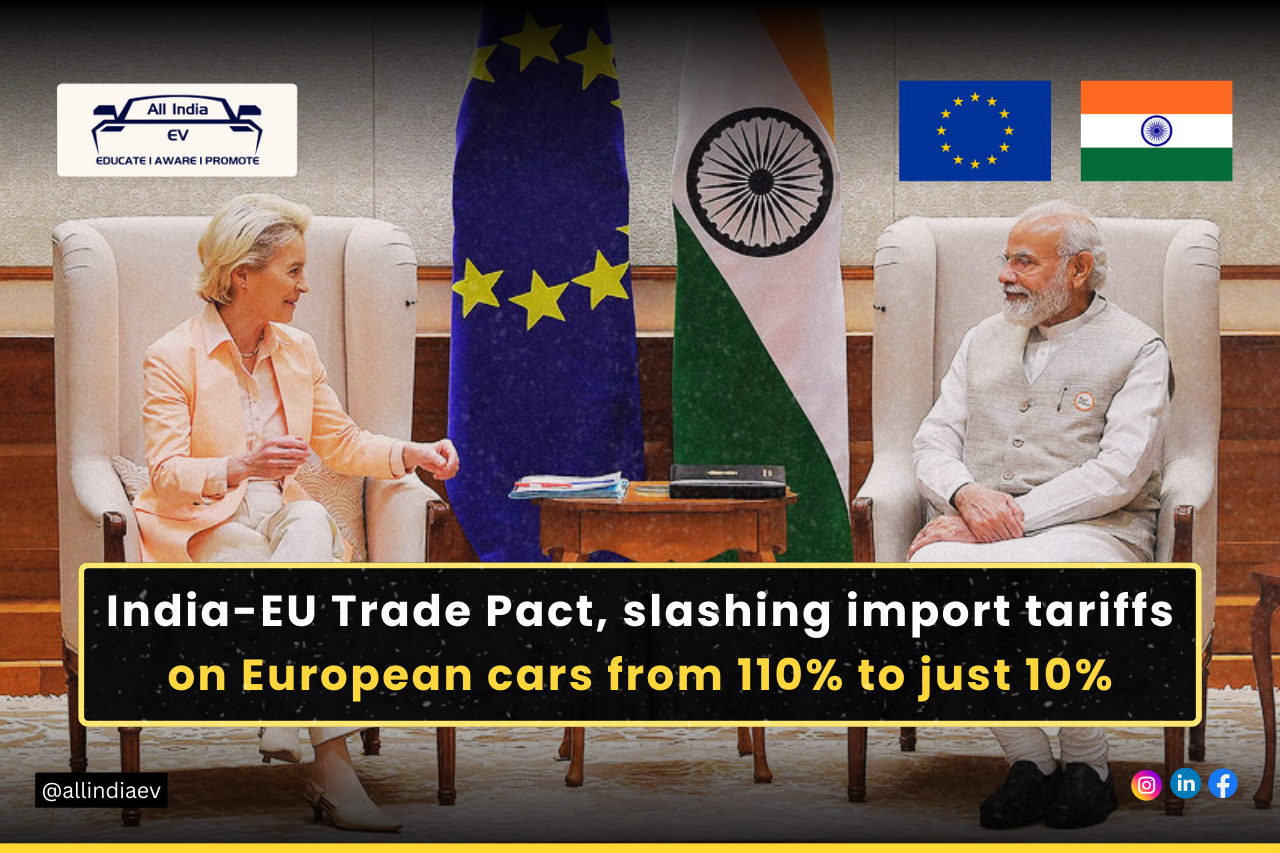
Under the agreement, India has committed to slashing import tariffs on European-built passenger vehicles from 110 per cent to 10 per cent, allowing up to 2,50,000 vehicles to enter the country at concessional duty rates. This marks one of India’s largest-ever tariff concessions in the auto sector, significantly exceeding quotas offered in other recent trade deals.
According to trade data, India imported motor vehicles worth more than €1.6 billion from the EU in 2024, underlining the bloc’s importance as a trading partner.
What the tariff cuts mean
Of the total quota agreed under the pact, around 1,60,000 internal combustion engine (ICE) vehicles will see import duties gradually reduced to 10 per cent within five years, while 90,000 electric vehicles (EVs) will be eligible for similar tariff benefits only by the tenth year of implementation.
Analysts say the move is likely to benefit Europe-based luxury automakers such as Audi, BMW and Mercedes-Benz, which import select models into India. However, its impact on the core of India’s auto market may be marginal.
India’s passenger vehicle landscape continues to be dominated by small and mid-sized cars priced between ₹10 lakh and ₹25 lakh, led by domestic and mass-market players such as Maruti Suzuki, Tata Motors, Mahindra & Mahindra and Hyundai Motor India.
More EV News

Ashim Sharma, Senior Partner and Business Unit Head at Nomura Research Institute, said the agreement leaves out the bulk of consumer demand.
“The deal excludes cars priced below ₹15 lakh and EVs in the near term, so it will not materially impact a large portion of the market,” he noted.
A departure from past FTAs
Experts describe the India–EU pact as a significant shift in India’s trade policy stance.
Saurabh Kanchan, Partner at Deloitte India, pointed out that India has rarely agreed to such deep tariff reductions in the passenger car segment.
“The key question will be whether India receives commensurate tariff cuts from the EU on vehicle and component exports especially as Indian manufacturers compete with suppliers from China and ASEAN markets,” Kanchan said.
Luxury carmakers, while welcoming the pact, remain cautious on its immediate commercial implications.
Santosh Iyer, CEO of Mercedes-Benz India, said the FTA could support technological innovation and sustainable mobility, but added that the agreement is unlikely to take effect before mid-2028, given the legal and regulatory processes involved.
Audi India head Balbir Singh Dhillon echoed similar sentiments, stating that pricing and product strategy decisions can only be evaluated once the final terms and timelines are clarified.
Localisation limits price impact
India’s long-standing push for localisation has already encouraged premium automakers to manufacture locally, limiting the scope for price reductions through imports.
At BMW Group India, over 95 per cent of sales come from locally manufactured models, while around 90 per cent of Mercedes-Benz India’s volumes are locally produced. As a result, both companies indicated that no immediate price cuts are expected due to the FTA.
Hardeep Singh Brar, President and CEO, BMW Group India, said the agreement may instead enable the introduction of niche and specialised models, with deeper localisation possible if demand scales.
Opportunities for global players
Global automaker Stellantis, which sells Jeep and Citroën in India, said the FTA could enhance access to advanced technologies and global product platforms, while strengthening India’s integration into international supply chains.
Boost expected for auto components
While passenger vehicle gains may be limited, the auto component industry is expected to emerge as a major beneficiary of the pact.
Industry body ACMA said the agreement could improve export competitiveness, encourage technology collaboration, and attract long-term investments, particularly as global supply chains realign amid uncertainty in Western markets.
In the first half of FY26, India exported $3.73 billion worth of auto components to the EU, while imports stood at $3.01 billion. Tariffs on components are expected to be fully eliminated over the next five to ten years.
Vikrampati Singhania, President of ACMA, said a balanced FTA could position India as a reliable manufacturing and sourcing hub for Europe.
Shailesh Chandra, President of SIAM and MD & CEO of Tata Motors Passenger Vehicles, described the agreement as a calibrated step that balances global participation with domestic investment and job creation.
However, industry leaders caution that effective implementation, regulatory alignment, and sustainability measures including carbon-related norms will be critical to fully unlocking the pact’s potential.