

This Initiative Aims to Reduce Imports and Strengthen Supply Chains Across States, With Approved Projects Focused on PCBs and Li-ion Cell Manufacturing
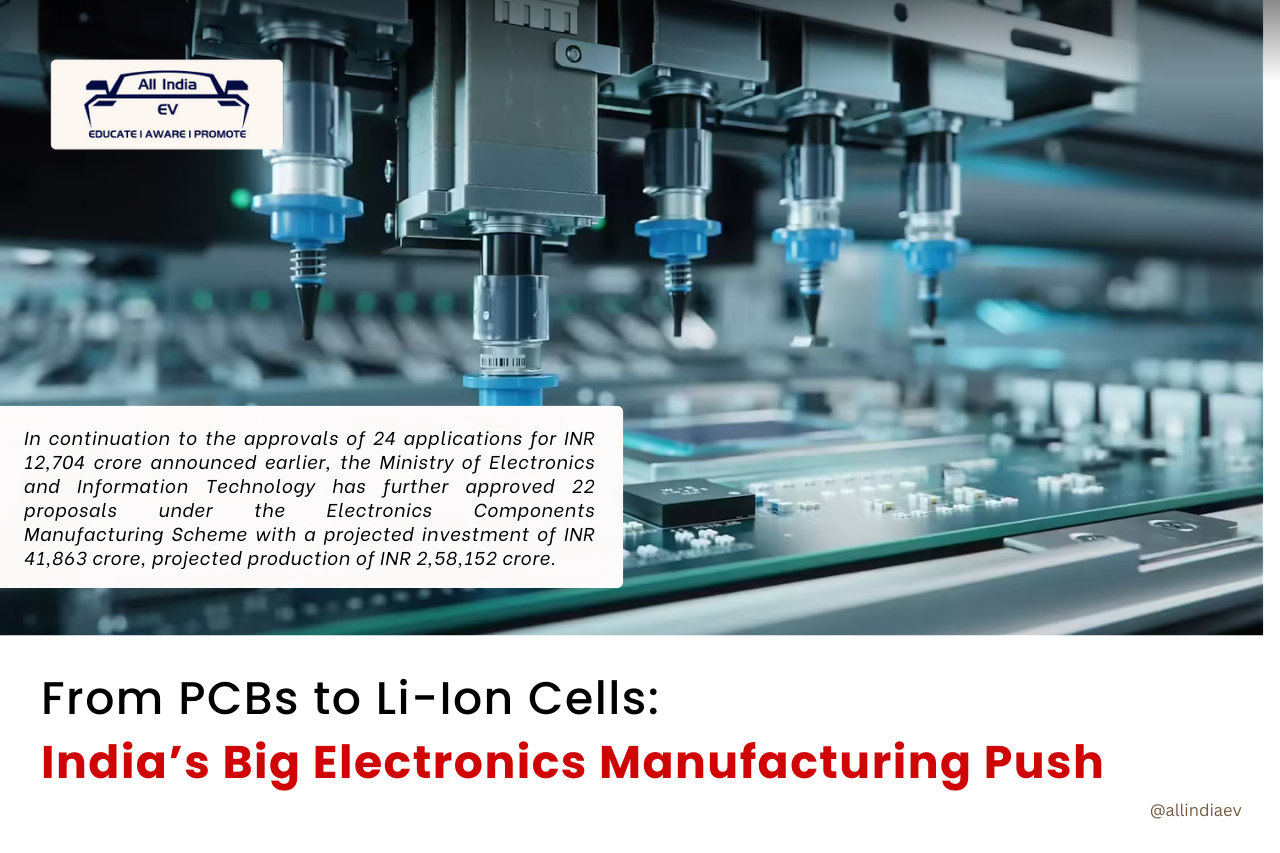
India’s Electronics Component Manufacturing Scheme (ECMS) — beyond its headline-grabbing investment figures — is emerging as a potential inflection point in how the country stitches together upstream electronics supply chains that are increasingly strategic for EVs and adjacent high-tech sectors. Recent approvals under the third tranche, totalling ~₹41,860 crore, signal more than capacity expansion; they indicate a deliberate attempt to rewire dependencies in critical inputs that have long constrained cost, quality, and resilience in Indian manufacturing.
From Import Reliance to Localised Production Capabilities
The distribution of recent approvals is telling. For PCBs (including high-density interconnect boards) alone, nine applicants have been sanctioned capacity build-out. In parallel, sanctioning of a first anode material plant and a second copper-clad laminate project addresses gaps in upstream feedstock — long overlooked in policy and industry dialogue. Sanctioned aluminium extrusion for mobile enclosures substitutes goods that were previously 100 % imported, and approval for domestic Li-ion cell manufacturing (for digital applications) broadens the localisation mandate beyond consumer gadgets.
Systems reflection: This is not merely import substitution — it’s value chain integration. By enabling upstream materials and sub-assemblies, ECMS moves India from low-value assembly towards deeper nodes where technology, tooling, and quality control create durable competitive advantage. For EV OEMs and battery ecosystems, such domestic nodes matter: PCBs and laminates influence system reliability; anode materials affect cell energy density; enclosure extrusions shape manufacturability and supply risk.
Geography and Ecosystem Readiness: A Multi-State Testbed
The 22 approved projects span eight states — including Karnataka, Maharashtra, Tamil Nadu, Uttar Pradesh, Andhra Pradesh, Rajasthan, Haryana, and MP — highlighting an evolution in policy execution from concentrated clusters to multi-nodal ecosystem development. Each state presents differing ease-of-doing-business, electrical infrastructure maturity, and skills pools.
Execution question: Can state-level ecosystem gaps be bridged fast enough to unify production flows, or will uneven infrastructure translate into logistic and quality-control inefficiencies? Central schemes can funnel capital, but local capacity for high reliability manufacturing — especially in precision electronics — remains a bottleneck unless accompanied by skills mapping, supplier development programmes, and standards enforcement.
More EV News
Capital Allocation and Real Production vs. Intent
ECMS filings show 46 applications with an aggregate investment intent of ~₹54,567 crore. Tranche-three alone is pegged at projected production of ₹2.58 lakh crore.
However, intent ≠ execution. Capital commitments are early-stage signals. The real test lies in:
- Tooling conversion rates: How many of these capital plans translate into commissioned plants on schedule?
- Absorption of global standards: Precision electronics manufacturing demands ISO/IPC compliance — not just capacity.
- Supply-demand alignment: OEMs must lock absorptive demand to justify capex; otherwise, facilities risk underutilisation.
For senior decision-makers at OEMs, Tier-1 parts producers, and utilities, this mismatch between announced investment and actual installed throughput will be the key metric for ecosystem confidence.
Strategic Significance for EV and Clean Tech Supply Chains
At a systems level, ECMS intersects with EV supply chains in non-obvious but potent ways:
- Li-ion cell upstream integration: Although current approvals are for cells serving digital and industrial electronics, the knowledge, talent pool, and materials ecosystem overlap with EV battery supply chains. Domestic anode material capacity can migrate into EV-grade chemistries if quality specs and standards evolve.
- PCB and sub-assembly localisation: EV controllers, BMS units, telematics modules, and power electronics rely on high-reliability PCBs. Import substitution here directly influences total system cost and reliability risk profiles for EV OEMs.
Thus, the scheme’s real downstream impact is cross-sectoral, touching consumer electronics, telecom, industrial automation — and crucially, electrified mobility and energy storage platforms.
Policy Intent vs. Industry Absorption
Officials frame ECMS as instrumental to India’s goal of a $500 billion electronics manufacturing ecosystem by 2030-31.
But policy efficacy requires confronting uncomfortable questions:
- Are incentives calibrated to global scale, or do they simply attract assembly-level play?
- Can India rise above its historical position as a low-cost assembler to become a trusted supplier of complex sub-assemblies?
For senior strategists and policymakers, ECMS must be viewed not as a headline budget line, but as a testbed for governance integration, standards readiness, and global value-chain anchoring — otherwise the country risks repeating a capital-inflated but structurally fragmented growth pattern that blunts export competitiveness.
Comment by Author
India’s ECMS should be read less as an incentive scheme and more as a stress test of India’s ability to execute deep supply-chain integration. The intent is directionally right—pushing upstream into materials, PCBs, and sub-assemblies that actually shape cost, reliability, and strategic autonomy for EVs and electronics.
But intent alone won’t close the gap. The real signal to watch is whether announced capital converts into globally compliant, fully utilised production lines. If execution, standards, and demand alignment lag, ECMS risks becoming another headline-driven investment cycle rather than the structural pivot India needs.