

India’s electric vehicle (EV) journey is no longer a futuristic ambition—it is a rapidly unfolding reality. As the country of over 1.4 billion people grapples with challenges of mobility, sustainability, energy efficiency, and digital security, the EV ecosystem is emerging as a powerful intersection of technology, infrastructure, data, and consumer-centric innovation. From charging networks expanding across highways and cities to telecom and digital platforms securing millions of connected devices, India’s EV story is being shaped by startups, enterprises, and technology leaders working together to redefine how the nation moves.
- EVs as the Next Frontier of Mobility and Sustainability
- Building India’s Largest EV Charging Network: The Statiq Story
- From Grit to Scale: The Early Challenges of EV Infrastructure
- Investor Sentiment: From Hesitation to Strategic Confidence
- Telecom, Sustainability, and the Digital Backbone of EVs
- Connected Vehicles, Data Platforms, and Real-Time Intelligence
- Security as the Bedrock of the Digital EV Ecosystem
- Customized Digital Solutions for EV Enterprises
- Customer Centricity: Beyond Buzzwords
- Statiq’s Three Pillars of Customer-Centric Charging
- Highway Confidence and Beyond-Charging Support
- Charging Infrastructure: Perception vs Reality
- Data, Privacy, and Enterprise Intelligence
- AI and Machine Learning: Powering Smarter EV Ecosystems
- AI, Jobs, and the Future of Work
- Purpose-Driven Technology for India’s Growth
- The Big Vision: The Future of Fueling
- Powering the Revolution Together
At the heart of this transformation lies a simple truth: mobility is essential, sustainability is inevitable, and technology—particularly EVs, AI, and digital security—is the next frontier for India’s growth.
EVs as the Next Frontier of Mobility and Sustainability
India’s mobility needs are immense. With a population larger than most continents, the country cannot rely indefinitely on fossil fuels and traditional transport systems. Climate concerns, rising fuel costs, urban congestion, and energy security have made the shift toward electric mobility not just desirable but unavoidable.
Electric vehicles are increasingly being seen as a solution that balances sustainability with scale. While adoption is still in its early stages in some segments, momentum is clearly visible across two-wheelers, three-wheelers, cargo vehicles, fleet operations, and ride-hailing services. From e-scooters and delivery fleets to Uber Green cars, EVs are steadily integrating into daily life.
Yet, EV adoption is not just about vehicles—it is about ecosystems. Charging infrastructure, digital platforms, data intelligence, cybersecurity, customer experience, and policy support must evolve in parallel for the transition to succeed.
Building India’s Largest EV Charging Network: The Statiq Story
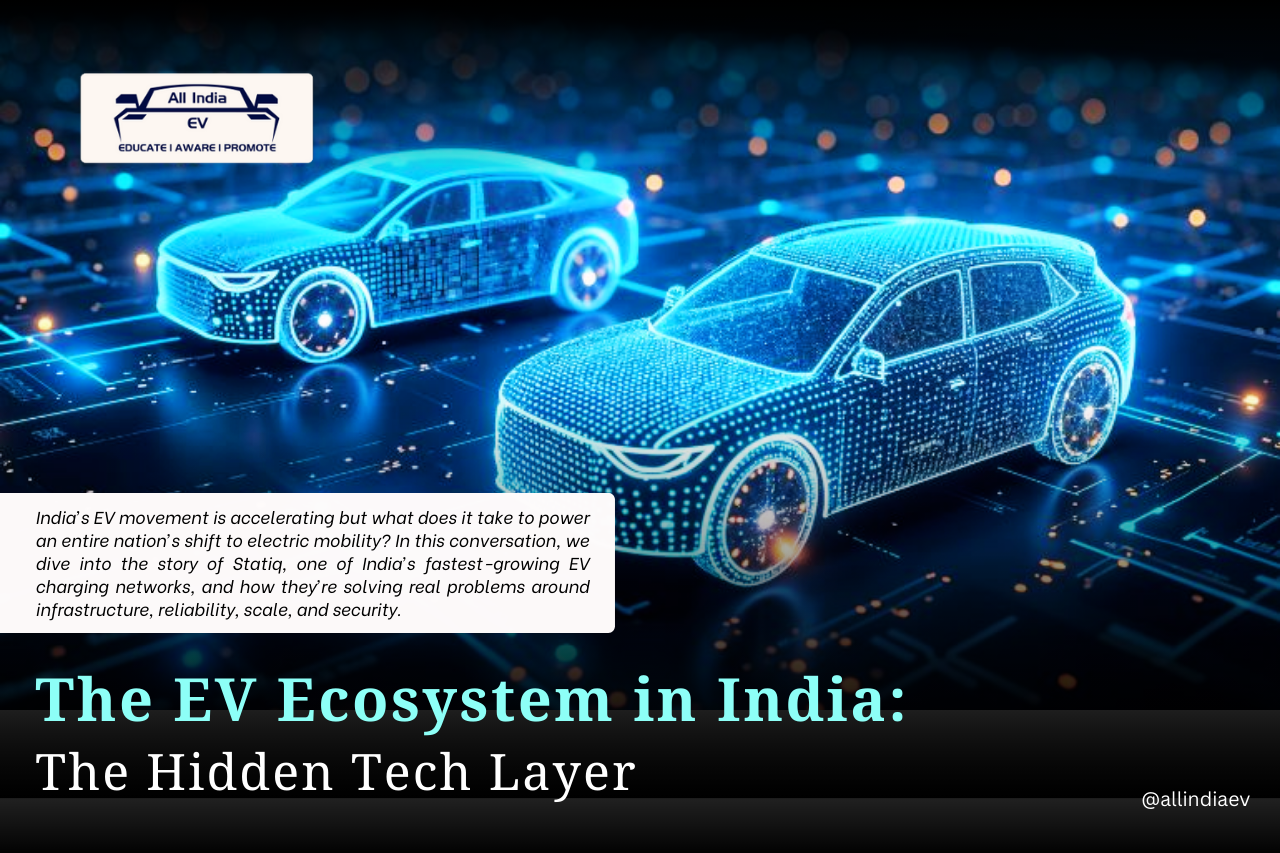
One of the most critical pillars of EV adoption is charging infrastructure. Addressing this challenge head-on is Statiq, a company that has emerged as one of India’s largest EV charging network operators.
Founded in 2019, at a time when India’s EV journey was just beginning, Statiq took on the daunting task of building charging infrastructure from the ground up. Today, the company operates over 7,000 EV chargers across the country, making it one of the most extensive networks in India.
More EV News

Key highlights of Statiq’s charging ecosystem include:
- A pan-India network of 7,000+ chargers, accessible via a single digital platform
- A vertically integrated model, where chargers are designed and manufactured in-house
- An intuitive mobile app that allows EV users to locate, reserve, and pay for charging seamlessly
- Deep partnerships with OEMs, ensuring charging access is integrated into vehicles from day one
Unlike traditional fuel stations, EV chargers are often unmanned and can be located in basements, parking lots, offices, malls, or residential complexes. This makes digital discovery and reliability crucial. Statiq’s platform addresses this by providing real-time information on charger availability, usage status, and reservation options—removing uncertainty from the charging experience.
From Grit to Scale: The Early Challenges of EV Infrastructure
Building EV infrastructure in India has not been easy. In the early days, the market was nascent, consumer awareness was limited, and investor confidence was cautious.
The journey demanded grit, patience, and belief in the long-term vision. With EV prices still evolving and adoption uncertain, charging companies had to invest ahead of demand. Statiq’s founders often stepped in personally to solve on-ground issues before dedicated teams were built.
Over time, however, multiple factors aligned:
- Price parity between EVs and internal combustion engine (ICE) vehicles
- Government incentives and subsidies
- Rising fuel costs pushing consumers toward electric alternatives
- Improved battery technology and vehicle performance
These shifts accelerated adoption, validating early infrastructure investments.
Investor Sentiment: From Hesitation to Strategic Confidence
One of the defining aspects of India’s EV ecosystem has been the evolving investor sentiment. Traditional venture capital firms, accustomed to software-led businesses, were initially hesitant to invest heavily in EV infrastructure—a capital-intensive and hardware-driven sector.
Statiq’s early funding journey reflected this hesitation. While some VCs took pioneering bets, many remained cautious. Over time, strategic investors began to see the bigger picture.
A major turning point came when Shell, a global energy giant, invested in the company. This marked a significant shift, signaling that even traditional oil players recognize the transition from fossil fuels to new forms of energy.
Despite progress, many believe that the VC ecosystem is still on the edge, waiting for larger success stories and scaled outcomes. Entrepreneurs scaling rapidly in EV infrastructure are expected to change this narrative, paving the way for broader capital inflows.
Telecom, Sustainability, and the Digital Backbone of EVs
As EVs become increasingly connected, digital infrastructure and telecom networks play a critical role in enabling and securing this transformation. This is where large telecom players like Airtel are making a significant impact.
Sustainability is no longer a peripheral goal—it is becoming central to corporate strategy. Airtel’s sustainability efforts extend across:
- Greener data centers powered increasingly by renewable energy
- Solar-powered telecom towers
- A clear roadmap toward net carbon neutrality for data centers in the coming years
Beyond internal sustainability, telecom networks are also powering the EV ecosystem itself.
Connected Vehicles, Data Platforms, and Real-Time Intelligence
Even before EV adoption scaled up, telecom platforms began preparing for a future of connected mobility. Initially focused on connected cars, these platforms evolved to support EV-specific use cases.
Key capabilities include:
- Real-time vehicle tracking
- Battery health monitoring and diagnostics
- Predictive alerts to reduce breakdowns
- Over-the-air firmware updates
- Integrated data platforms for fleet and OEM insights
This intelligence helps reduce range anxiety, improve vehicle reliability, and optimize performance—critical factors for consumer confidence.
Security as the Bedrock of the Digital EV Ecosystem
As vehicles, chargers, and users become digitally connected, security becomes non-negotiable.
With over 400 million customers and a massive B2B ecosystem, telecom providers carry the responsibility of protecting users from cyber threats, fraud, and data breaches.
Security principles guiding the ecosystem include:
- Embedding security by design across platforms
- AI-driven real-time threat detection
- Network-level intelligence to identify fraud and spam
- Enterprise-grade protection for connected devices and infrastructure
One visible example is AI-powered spam detection, which alerts users to potential fraud calls and messages in real time. This same intelligence framework can be extended to protect EV platforms, charging networks, and connected infrastructure.
Customized Digital Solutions for EV Enterprises
For EV companies like Statiq, telecom platforms provide customized digital solutions that enhance operations and customer engagement.
These solutions enable:
- Real-time communication with customers across voice, messaging, and digital channels
- Predictive insights on charger connectivity and uptime
- Next-best-action intelligence for service, sales, and support
- Secure IoT connectivity using enterprise-grade SIMs
By integrating these tools, EV operators can move from reactive troubleshooting to proactive issue resolution, improving reliability and user trust.
Customer Centricity: Beyond Buzzwords
In a rapidly evolving ecosystem, customer centricity is not a slogan—it is a survival strategy.
For technology and EV companies alike, this translates into three core principles:
- Listening deeply to customers to identify real pain points
- Empowering frontline teams with tools and decision-making authority
- Encouraging cross-functional collaboration to solve problems at scale
A powerful example comes from logistics and manufacturing, where companies struggled to track pallets and high-value goods. By listening to customer needs, a low-cost tracking device was developed—small, long-lasting, and easy to deploy—eliminating losses without complex reverse logistics.
Statiq’s Three Pillars of Customer-Centric Charging
For EV users, Statiq has distilled customer needs into three non-negotiables:
- Accessibility – Chargers must be available as close as possible to where users need them
- Reliability – Once found, a charger must work 100% of the time
- Affordability – Charging must remain economical to justify the shift to EVs
To deliver on these pillars, Statiq has built:
- An aggregated EV charging marketplace
- End-to-end control over hardware and software
- An in-house customer support team, not outsourced
- Remote troubleshooting capabilities, including charger resets and connector unlocking
Highway Confidence and Beyond-Charging Support
One of the biggest psychological barriers to EV adoption has been range anxiety, especially on highways.
To address this, Statiq has extended its services beyond charging:
- Tie-ups with tow truck operators, accessible via app or customer support
- On-ground teams in cities for rapid issue resolution
- Dedicated highway runners who monitor routes and assist stranded vehicles
- Support for towing vehicles to charging stations or service centers
These measures ensure that EV users—especially families on long drives—feel confident relying on electric mobility.
Charging Infrastructure: Perception vs Reality
Interestingly, charging infrastructure is often cited as a major challenge by those who do not own EVs. In contrast, existing EV users increasingly report fewer concerns, as infrastructure expands rapidly across offices, residential societies, highways, and public spaces.
This gap between perception and reality highlights the importance of awareness, visibility, and user experience in accelerating adoption.
Data, Privacy, and Enterprise Intelligence
With vast amounts of data flowing through connected systems, privacy remains paramount. Enterprises do not access personal customer data but can leverage insights from their own operational data.
For EV networks, this enables:
- Predictive alerts for charger downtime
- Proactive maintenance scheduling
- Battery health notifications for users
- Network optimization based on usage patterns
Instead of waiting for customer complaints, operators can act before issues arise—dramatically improving reliability.
AI and Machine Learning: Powering Smarter EV Ecosystems
Artificial intelligence is playing an increasingly critical role across the EV value chain.
Applications include:
- Identifying optimal locations for new chargers based on utilization data and vehicle movement
- Optimizing charging behavior to extend battery life
- Analyzing mobility patterns to identify charging hotspots
- Enhancing fraud detection and network security in real time
AI transforms raw data into actionable intelligence, enabling smarter decisions at scale.
AI, Jobs, and the Future of Work
While concerns persist about AI replacing jobs, industry leaders see it as a tool for efficiency and productivity, rather than displacement.
Historically, every major technology shift—from industrialization to computers—has reshaped jobs rather than eliminated work entirely. AI is expected to recast roles, creating new opportunities while requiring reskilling.
The consensus is clear: those who adapt and reskill will thrive in the AI-driven economy.
Purpose-Driven Technology for India’s Growth
Looking ahead, technologies like AI, clean energy, EVs, telecom, and smart infrastructure are expected to play a defining role in India’s growth story.
Smart meters, for example, are already transforming the power sector by reducing losses, enabling prepaid consumption, balancing loads, and improving efficiency across millions of homes.
These technologies create equal opportunities, optimize limited resources, and support sustainable development at scale.
The Big Vision: The Future of Fueling
For Statiq, the ambition goes far beyond EV charging. The long-term vision is to become the future of fueling—distributing not just electricity, but any alternative fuel that emerges, whether hydrogen or beyond.
The dream is bold: to build one of the world’s largest alternative fuel distribution companies, originating from India.
Powering the Revolution Together
As India’s EV ecosystem matures, one message stands out: no single player can drive this revolution alone. Charging networks, telecom platforms, AI, security systems, policymakers, investors, and consumers must move in sync.
Every new charger installed, every secure connection enabled, and every EV charged successfully is a step toward a cleaner, smarter, and more sustainable India.
The EV revolution is not just about vehicles—it is about reimagining mobility, energy, and technology for the next generation.