
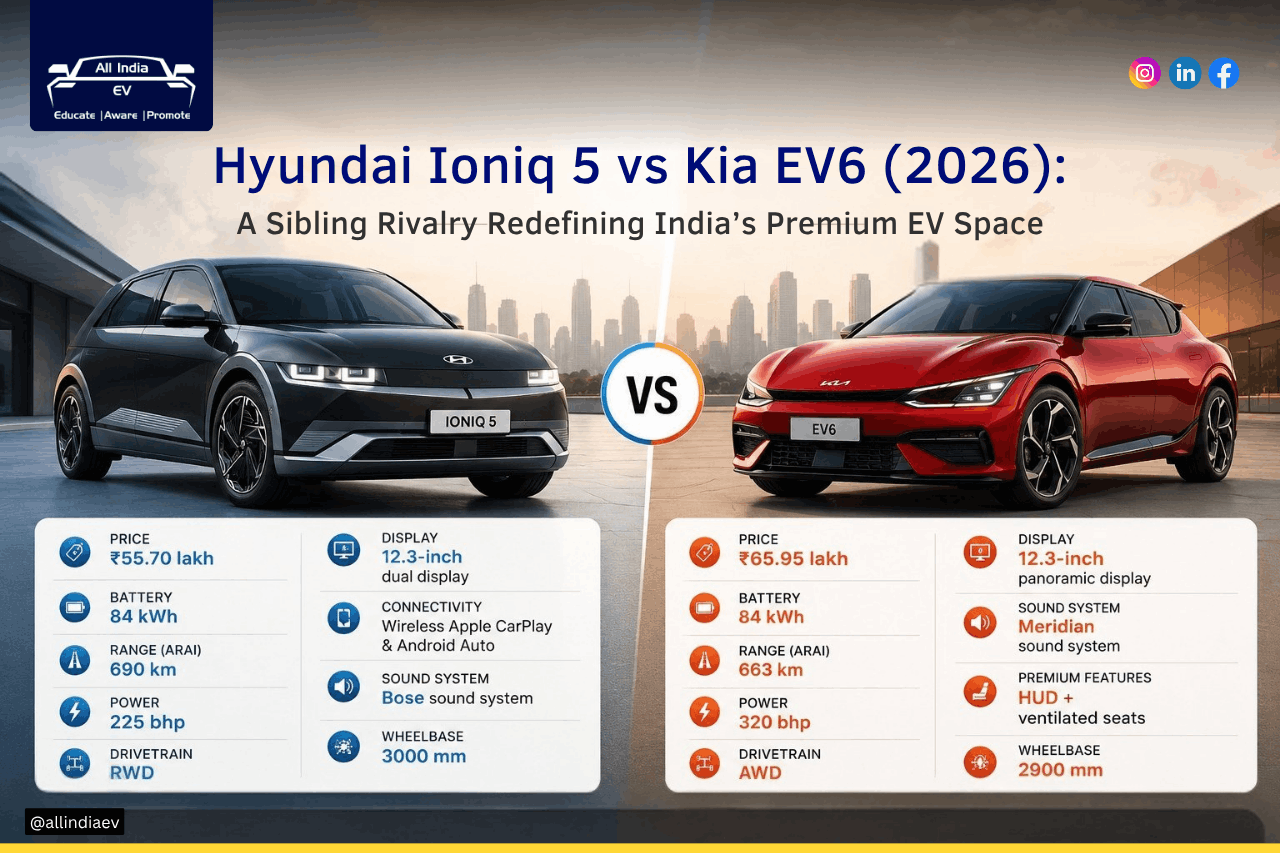

What: The updated 2026 versions of the Hyundai Ioniq 5 and Kia EV6 have entered the spotlight with revised battery packs, longer driving range, updated features, and refreshed positioning in India’s premium EV market.
The Number: The Kia EV6 now offers up to 663 km claimed range, while the Hyundai Ioniq 5 delivers up to 631 km on a single charge under ARAI-certified testing cycles.
The Impact: The premium electric SUV segment in India is becoming more competitive as automakers focus on larger battery packs, faster charging capability, and long-range usability for intercity travel.

The Core News
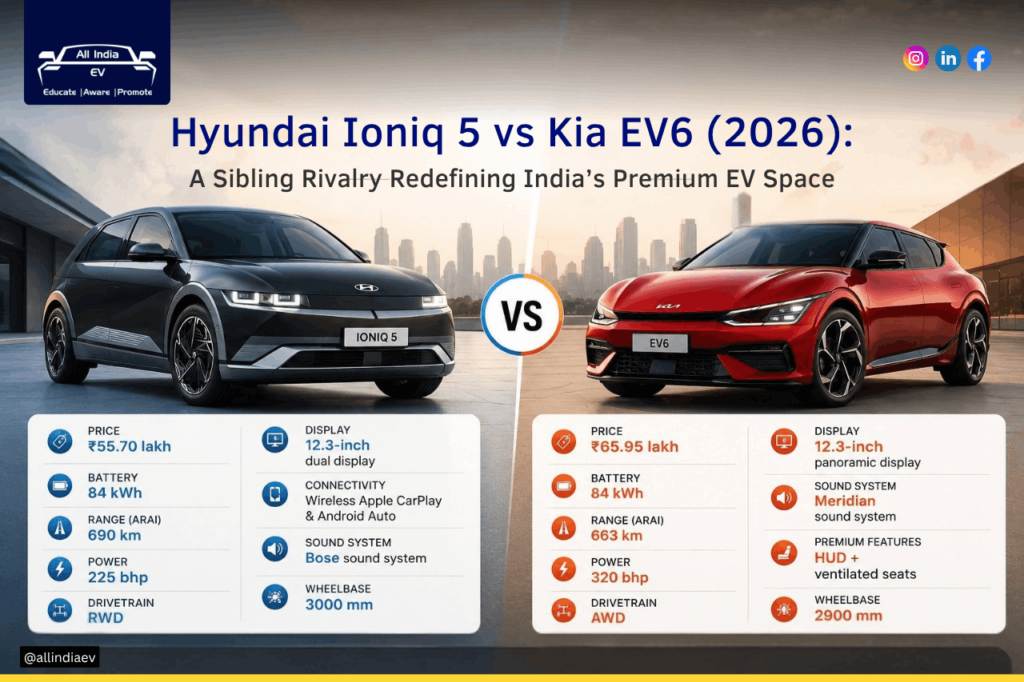
The 2026 Hyundai Ioniq 5 vs Kia EV6 comparison highlights how Korean automakers are aggressively refining their premium EV offerings for global and Indian markets. Both models are based on Hyundai Motor Group’s E-GMP dedicated EV platform, which supports 800V ultra-fast charging architecture, vehicle-to-load functionality, and long wheelbase packaging. However, the two vehicles now target slightly different customer priorities despite sharing the same core platform.
The Kia EV6 has received a larger 84 kWh battery pack and updated aerodynamic improvements, helping it push its claimed range beyond 660 km. Hyundai’s Ioniq 5, meanwhile, continues to position itself as a more comfort-focused electric crossover with retro-inspired styling, spacious cabin architecture, and balanced ride quality. Both EVs support DC fast charging capabilities that can charge the battery from 10% to 80% in under 20 minutes under ideal charging conditions.
Pricing remains a key differentiator in the Indian market. The Hyundai Ioniq 5 continues to sit at a lower price point compared to the Kia EV6, making it relatively more accessible for premium EV buyers. The EV6, however, offers more performance-oriented tuning, additional premium features, and all-wheel-drive capability in select global variants. As India’s charging infrastructure expands, long-range premium EVs are increasingly targeting buyers looking for highway usability instead of only city commuting.
More EV News
Breaking Down the Update
• Kia EV6 gets a larger 84 kWh battery pack for 2026
• Hyundai Ioniq 5 continues using E-GMP dedicated EV platform
• Kia EV6 claimed range reaches 663 km
• Hyundai Ioniq 5 claimed range stands at 631 km
• Both EVs support 800V ultra-fast charging architecture
• DC fast charging can deliver 10-80% charging in under 20 minutes
• Hyundai positions Ioniq 5 as a comfort-focused crossover
• Kia EV6 targets premium performance EV buyers
• Both vehicles support Vehicle-to-Load (V2L) functionality
• India’s premium EV segment is witnessing rising competition from global brands
How 2026 Hyundai Ioniq 5 vs Kia EV6 will help Indian EV Market
The 2026 Hyundai Ioniq 5 vs Kia EV6 comparison reflects the growing maturity of India’s premium electric vehicle ecosystem. While sales volumes in this segment remain relatively limited compared to mass-market EVs, flagship long-range models play an important role in shaping consumer confidence around electric mobility.
These vehicles demonstrate that EVs are now capable of supporting long-distance intercity travel without major compromises in charging speed or cabin comfort. Their 800V charging systems also push charging infrastructure providers to develop higher-capacity fast charging corridors across highways and metro regions.
For the Indian market, premium EVs act as technology demonstrators that eventually influence mass-market vehicle development. Features like advanced battery thermal management, V2L capability, ultra-fast charging, and software-defined vehicle systems gradually move into lower-priced segments over time.
The presence of both Hyundai and Kia in India’s premium EV space also increases competitive pressure on European luxury automakers and upcoming Chinese EV entrants. This could lead to better localisation strategies, improved battery sourcing, and more aggressive pricing structures in the future.
As charging infrastructure improves and battery costs continue declining, premium long-range EVs could help accelerate broader EV acceptance among Indian consumers who still associate electric vehicles with limited driving range and charging anxiety.
Way Forward …
The 2026 Hyundai Ioniq 5 vs Kia EV6 battle reflects a larger transition underway in India’s premium EV market. The focus is shifting from basic electrification to range efficiency, charging speed, software integration, and highway practicality. Going forward, execution around pricing, charging network reliability, and localisation will determine how successfully these premium EVs scale in India’s evolving electric mobility landscape.
Read More: Catch up on All India EV’s related coverage on India’s evolving commercial EV subsidies and battery swapping policies at All India EV