

Government Proposes Raising EV R&D Fund from ₹5 Crore to ₹100 Crore to Boost Battery, Charging and EV Technology Innovation
The Delhi government is preparing to roll out an ambitious Electric Vehicle (EV) Policy 2.0, signalling a renewed push to accelerate clean mobility adoption in the national capital. The proposed policy, currently under review, aims to revive consumer subsidies, expand EV adoption targets, promote local manufacturing, and strengthen power and charging infrastructure to support the next phase of electric mobility.
The current Delhi EV Policy, which was set to expire this year, has been extended until March 2026 or until the new policy is officially notified. According to officials, Delhi EV Policy 2.0 is expected to be unveiled in the first quarter of 2026, following public consultations and stakeholder feedback.
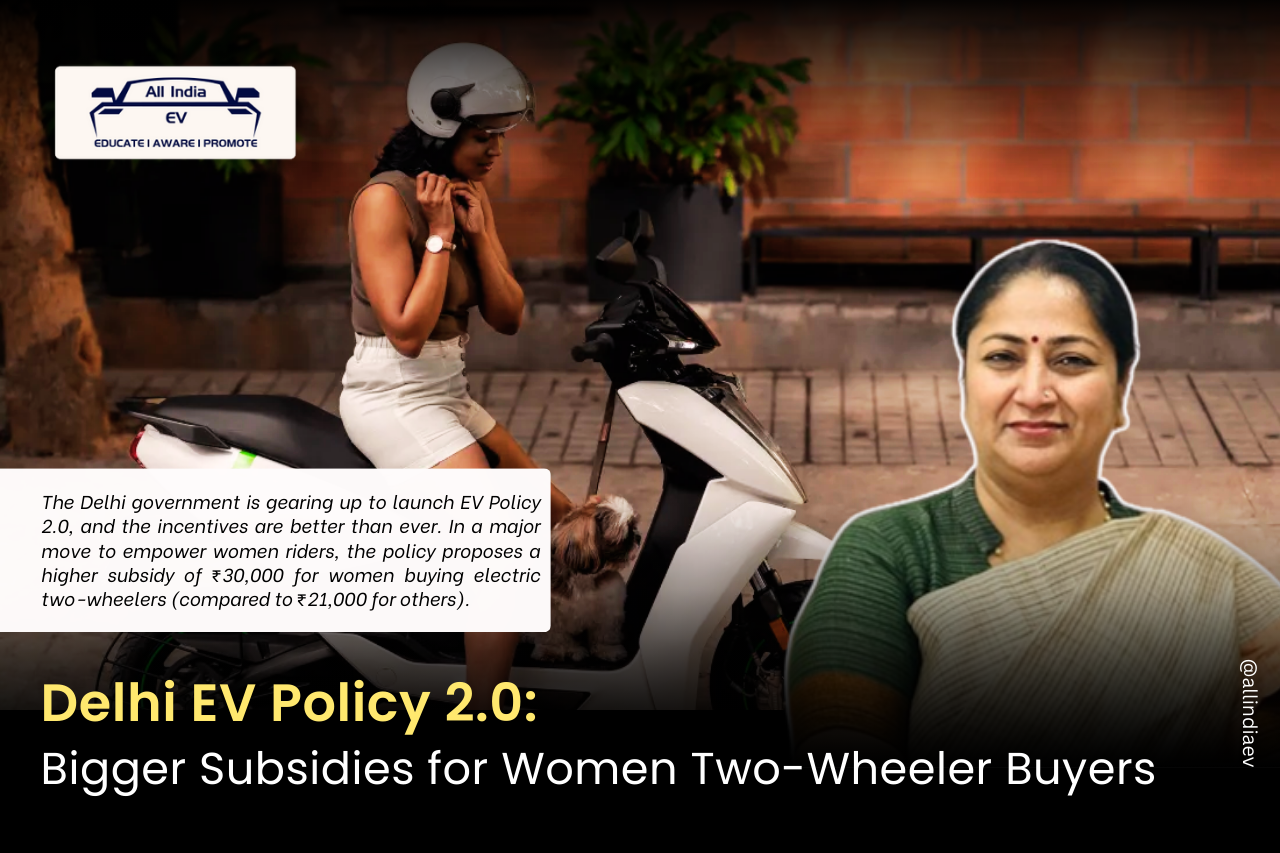
Higher Subsidies for Electric Two-Wheelers, Extra Push for Women Buyers
As per the Delhi EV Policy 2.0 recommendation documents, the policy places its strongest emphasis on electric two-wheelers (e2Ws), which are seen as the fastest route to mass electrification. The government has proposed a subsidy of ₹21,000 per electric two-wheeler, while women buyers are likely to receive a higher incentive of ₹30,000 per vehicle to encourage greater participation and adoption.
The number of subsidised electric two-wheelers may be capped at one lakh units, but the government plans to raise its overall e2W adoption target sharply—from the existing five lakh to 12 lakh vehicles in the coming years.
₹50,000 Incentive for Retrofitting Old Cars into EVs
In a first-of-its-kind initiative, the proposed policy includes an incentive of ₹50,000 for retrofitting petrol or diesel cars into electric vehicles, limited to the first 1,000 cars. Retrofitting involves replacing the internal combustion engine and related components with an electric powertrain.
A transport department official said the government plans to invest more in research and development and consult industry specialists to better understand the retrofitting ecosystem. Given the high costs associated with conversions, subsidy support is being explored to make retrofitting a viable option for vehicle owners.
More EV News
The policy also proposes a scrapping-linked incentive for old two-wheelers, three-wheelers and light commercial vehicles, effectively tying EV adoption to the phasing out of high-polluting vehicles.
Subsidies Return for Electric Cars, with Price Cap
For four-wheelers, the Delhi government plans to reintroduce subsidies with stricter eligibility criteria. Officials said private electric cars priced below ₹25 lakh would qualify for incentives, ensuring support is directed towards the mass-market segment rather than premium EVs.
Under the proposal, buyers could receive an incentive of ₹10,000 per kWh of battery capacity, capped at ₹1 lakh per vehicle, applicable to the first 27,000 private electric cars. To ease financing challenges, the policy also recommends an interest subvention scheme, under which the government would bear 5% of the loan interest for eligible EV buyers.
How It Compares with the Current Policy
Under the existing Delhi EV Policy, electric two-wheelers receive ₹5,000 per kWh of battery capacity, capped at ₹30,000, while electric three-wheelers get a flat ₹30,000 subsidy. Subsidies for electric cars were discontinued after the first 1,000 registrations due to fund exhaustion.
Big Push for Local Manufacturing and R&D
On the supply side, EV Policy 2.0 places strong emphasis on domestic manufacturing. Companies manufacturing EV components locally may receive financial incentives, aligning Delhi’s policy with the Centre’s ‘Make in India’ initiative and supporting job creation across the region’s industrial ecosystem.
The government is also proposing a massive increase in the research and development corpus—from ₹5 crore to ₹100 crore. This fund would support innovation in battery technology, charging infrastructure, and advanced EV solutions.
An official confirmed that the proposal was discussed at a high-level meeting earlier this week, adding, “There may be some changes in the final policy, but the direction and intent will remain the same.”
If implemented as proposed, Delhi EV Policy 2.0 could significantly reshape EV adoption, making electric mobility more affordable, inclusive, and manufacturing-driven in one of India’s most critical urban markets.
Comment by Author:
Delhi EV Policy 2.0 signals a renewed and more inclusive approach to electric mobility, with a clear focus on affordability, gender participation, and cleaner urban transport. By combining higher consumer subsidies, support for retrofitting, and incentives for local manufacturing, the proposed policy aims to balance demand growth with ecosystem development. If implemented effectively, it could serve as a template for other states seeking to accelerate EV adoption while addressing infrastructure and cost challenges.