
All India EVAll India EVAll India EV
Notification
Font ResizerAa
  • Home
  • EV News
  • EV Launch
  • Market Insights
  • Investments & Funding
  • Guest Articles
  • EV Engineering
  • Contact
Reading: Setback for EVs? Automakers Resist GST Hike, Urge Retaining 5% Rate
Share
All India EVAll India EV
Font ResizerAa
  • Home
  • EV News
  • EV Launch
  • Market Insights
  • Guest Articles
  • EV Engineering
  • Contact
Search
  • Home
    • Home 1
    • Home 2
    • Home 3
    • Home 4
    • Home 5
  • Home
  • Categories
    • Electric
  • Categories
  • Shows
    • Rap
  • More Foxiz
    • Blog Index
    • Contact
  • Bookmarks
    • Customize Interests
    • My Bookmarks
  • More Foxiz
    • Blog Index
    • Sitemap
Have an existing account? Sign In
Follow US
Automakers Oppose GST
Home » Blog » Setback for EVs? Automakers Resist GST Hike, Urge Retaining 5% Rate
EV News

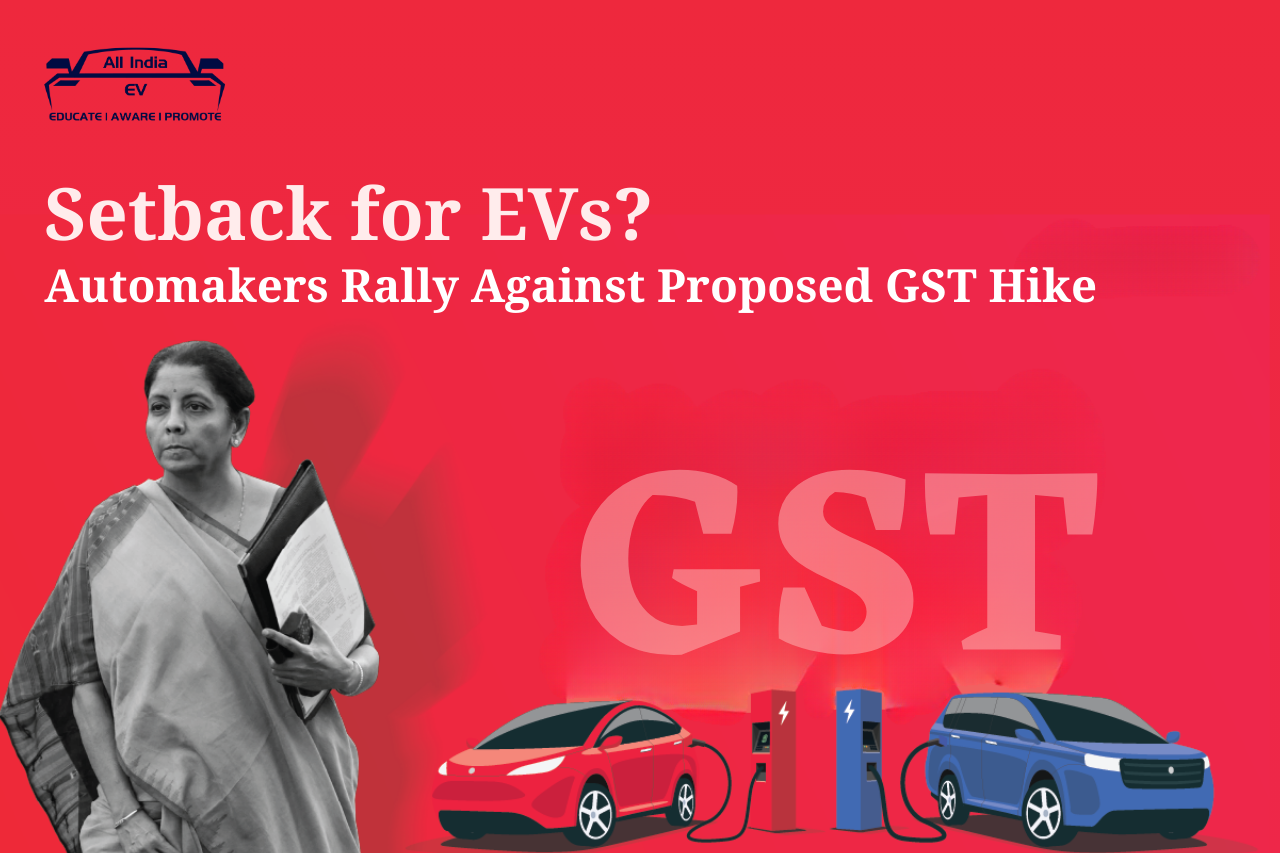
Setback for EVs? Automakers Resist GST Hike, Urge Retaining 5% Rate

Sunita
By
Sunita
Last updated: 2 September 2025
Share
4 Min Read
SHARE

EV Makers Oppose GST Hike on Premium Models, Urge Retaining 5% Rate to Safeguard Adoption and Support India’s Clean Mobility Transition

Contents
  • Rising sales show EV momentum
  • Industry pushes for consistent policy
  • What’s at stake

India’s electric vehicle (EV) industry is voicing strong resistance to a proposed hike in the Goods and Services Tax (GST) on premium EVs, warning that it could derail the country’s clean mobility transition at a pivotal stage.

The GST rationalization group of ministers (GoM) has suggested increasing the tax rate on EVs priced above ₹20 lakh from 5% to 18%. While the GST Council has yet to take a final decision, even the proposal has rattled automakers, who say it is already affecting consumer sentiment.

Tata Motors’ Managing Director Shailesh Chandra underscored the sector’s progress—EVs delivering over 500 km range, a network of 24,000+ public charging points, and competitive pricing against conventional SUVs. He warned that higher taxes could undermine this momentum. “It is imperative that the 5% GST rate for EVs be retained. Any upward revision will slow India’s transition to clean mobility, dilute environmental benefits, and impact the nation’s zero-emission goals,” Chandra told The Economic Times.


Rising sales show EV momentum

India’s electric car market is expanding rapidly. In July 2025, 15,528 EV units were sold, representing a 93% year-on-year growth, according to the Federation of Automobile Dealers Associations (FADA). EVs accounted for 4.7% of total passenger vehicle sales, up from 2.4% in July 2024, highlighting growing consumer acceptance.

However, industry executives warn that the proposed tax hike could make nearly one-quarter of EVs above ₹20 lakh significantly more expensive, discouraging potential buyers.

Industry pushes for consistent policy

A Mahindra & Mahindra spokesperson said keeping GST at 5% is vital to ensure price parity with internal combustion engine (ICE) vehicles and to develop the ₹10–40 lakh EV segment, which is crucial for India’s global competitiveness in the EV space.

More EV News
Joy e-bike achieves mega milestone in strengthening its distribution network
Tesla’s $1 Trillion Pay Package for Elon Musk Sparks Governance Concerns
ElectroRide Partners with Battery Smart to Establish 2,500 Battery Swapping Stations Across India
Epsilon Carbon aims 6-Month period for Battery Partnerships
Battery Smart Hits 50 Million Battery Swaps Milestone

Anurag Mehrotra, Managing Director of JSW MG Motor India, stressed the need for predictable regulations: “To sustain EV adoption, India requires stable long-term policies, accelerated CAFE norms, and zero percent GST on fully electric vehicles. Investments in charging infrastructure and easing home charging access will also be critical.”

Premium car manufacturers have echoed similar concerns. While high-end buyers may absorb price hikes, entry-level luxury EVs are expected to face significant headwinds if the tax is raised. Mercedes-Benz India’s MD and CEO, Santosh Iyer, pointed out that the current 5% GST rate has been instrumental in building necessary sales volumes and fast-tracking battery electric vehicle (BEV) adoption.


What’s at stake

Automakers argue that raising GST now could derail years of progress. Industry leaders have collectively invested billions in local production, supply chains, and research to make EVs cost-competitive. A sudden spike in taxes, they say, could not only dampen consumer enthusiasm but also discourage further investments.

With India aspiring to become a global EV hub, industry experts stress that policy stability is non-negotiable. The coming months will be critical as the GST Council deliberates on the proposal.
Join All India EV Community

Click here for more such EV Updates

India’s First Woman-Led EV Bike Startup, Oben Electric, Secures Funding to Expand Nationwide Operations
Ola Unveils Its Electric Bikes at MotoGP Bharat Event
EV Skateboard Explain: Types, Features and Manufactures
Piaggio Vehicles Partners with Manba Finance for Tailored Electric Three-Wheeler Financing Solutions
Orxa Energies Collaborates with Nunam Tech for Reuse of EV Batteries in Second-Life Applications

Sign Up For Daily Newsletter

Be keep up! Get the latest breaking news delivered straight to your inbox.
Loading
By signing up, you agree to our Terms of Use and acknowledge the data practices in our Privacy Policy. You may unsubscribe at any time.
Share This Article
Facebook Whatsapp Whatsapp LinkedIn Copy Link Print
Leave a Comment

Leave a Reply Cancel reply

Your email address will not be published. Required fields are marked *

Follow US
XFollow
InstagramFollow
YoutubeSubscribe
LinkedInFollow
Haryana cabinet approves new rules: No petrol, diesel vehicles for cab aggregators in NCR
21 May 2026
Ultraviolette and Bolt.Earth Expand Type-6 DC Fast Charging Infrastructure Across India
Ultraviolet and Bolt. Earth Expand Type-6 DC Fast Charging Infrastructure Across India
21 May 2026
What: India’s finance ministry has directed public sector banks, insurers, and financial institutions to reduce operational spending and accelerate adoption of electric vehicles across official fleets. The move is part of a wider austerity push linked to rising global economic uncertainty and fuel-related risks. The Number: The directive impacts major public institutions including State Bank of India, Bank of Baroda, and Life Insurance Corporation of India, covering millions of employees and thousands of operational vehicles nationwide. The Impact: The policy signals a new phase of institutional fleet electrification in India, where EV adoption is now being tied directly to fiscal discipline, fuel import management, and public-sector operational efficiency. The Core News India’s finance ministry has formally instructed state-run financial institutions to implement strict expenditure controls while simultaneously accelerating EV adoption for official transport operations. The directive from the Department of Financial Services asks organisations to replace petrol and diesel vehicles used at head offices and branch operations with electric vehicles “as far as possible.” The order comes amid growing concern over the economic impact of prolonged geopolitical instability in West Asia, which threatens to increase crude oil prices, widen India’s import bill, and pressure the rupee. Alongside the EV transition mandate, the government has also pushed virtual meetings, reduced foreign travel, and tighter administrative spending controls across public-sector institutions. For India’s EV ecosystem, the directive is strategically important because it expands demand visibility beyond state transport undertakings and government departments into the financial sector itself. PSU banks and insurers operate one of the country’s largest distributed office networks, including regional offices, branch fleets, field operations, and administrative mobility services. Even a phased transition could create a sizeable procurement pipeline for electric passenger vehicles, charging infrastructure providers, and fleet management companies. Breaking Down the Update • The Department of Financial Services issued the austerity and EV adoption directive to PSU banks, insurers, and financial institutions. • The government wants petrol and diesel vehicles used in official operations to be progressively replaced by EVs wherever operationally feasible. • The policy push follows Prime Minister Narendra Modi’s appeal for fuel conservation and controlled discretionary spending amid global energy uncertainty. • The directive also mandates greater use of video conferencing to reduce travel-related operational expenditure. • The move could indirectly support domestic EV OEMs, leasing firms, and charging infrastructure operators through institutional procurement demand. • The banking and insurance sector may emerge as a new enterprise fleet electrification category in India’s EV transition roadmap. How PSU banks EV adoption will help Indian EV Market The expansion of PSU banks EV adoption could create a strong institutional demand layer for India’s electric mobility sector. Public sector banks and insurers operate thousands of branch offices across urban, semi-urban, and rural India. Their transition to EV fleets can generate predictable procurement volumes for domestic automakers, especially in the electric sedan, compact SUV, and commercial mobility segments. Beyond vehicle sales, the policy may also accelerate deployment of workplace charging infrastructure at bank headquarters, zonal offices, and regional branches. This can support charger utilisation economics while helping normalise EV infrastructure in tier-2 and tier-3 cities. Another important impact is signalling. When large state-linked financial institutions adopt EVs as operational assets rather than pilot projects, it improves confidence across the broader enterprise mobility market. Private banks, NBFCs, and insurance firms could eventually follow similar fleet transition models to reduce long-term fuel and maintenance costs. PSU banks EV adoption also aligns with India’s larger energy security strategy. Lower petroleum consumption in institutional fleets directly supports efforts to reduce crude import dependence while stabilising operational expenditure during periods of volatile global oil prices. Conclusion & Next Steps The government’s push toward PSU banks EV adoption reflects a broader shift where EV deployment is increasingly being linked with macroeconomic resilience rather than only sustainability targets. Execution, however, will depend on procurement timelines, charging infrastructure readiness, and operational suitability across
India directs state-run banks, insurance firms to cut costs, shift to EVs
21 May 2026
All India EV: Edition 49
What all happened in April 2026?
Click Here
All India EV

Daily EV Industry updates for you…

Categories

  • EV News
  • EV Launch
  • Investments & Funding
  • Market Insights
  • Guest Articles
  • EV Engineering

Quick Links

  • Community
  • Content Services
  • Branding Services
  • My EV Charger
  • Substack

© Developed and Managed by “The Energy Log”

Welcome Back!

Sign in to your account

Username or Email Address
Password

Lost your password?

Not a member? Sign Up