
All India EVAll India EVAll India EV
Notification
Font ResizerAa
  • Home
  • EV News
  • EV Launch
  • Market Insights
  • Investments & Funding
  • Guest Articles
  • EV Engineering
  • Contact
Reading: The Billion-Dollar Potential of India’s EV Leasing Market
Share
All India EVAll India EV
Font ResizerAa
  • Home
  • EV News
  • EV Launch
  • Market Insights
  • Guest Articles
  • EV Engineering
  • Contact
Search
  • Home
    • Home 1
    • Home 2
    • Home 3
    • Home 4
    • Home 5
  • Home
  • Categories
    • Electric
  • Categories
  • Shows
    • Rap
  • More Foxiz
    • Blog Index
    • Contact
  • Bookmarks
    • Customize Interests
    • My Bookmarks
  • More Foxiz
    • Blog Index
    • Sitemap
Have an existing account? Sign In
Follow US
Home » Blog » The Billion-Dollar Potential of India’s EV Leasing Market
EV News

The Billion-Dollar Potential of India’s EV Leasing Market

Ankit Sharma
By
Ankit Sharma
ByAnkit Sharma
Follow:
Last updated: 29 August 2024
Share
7 Min Read
SHARE
The Billion-Dollar Potential of India's EV Leasing Market

The Billion-Dollar Potential of India’s EV Leasing Market

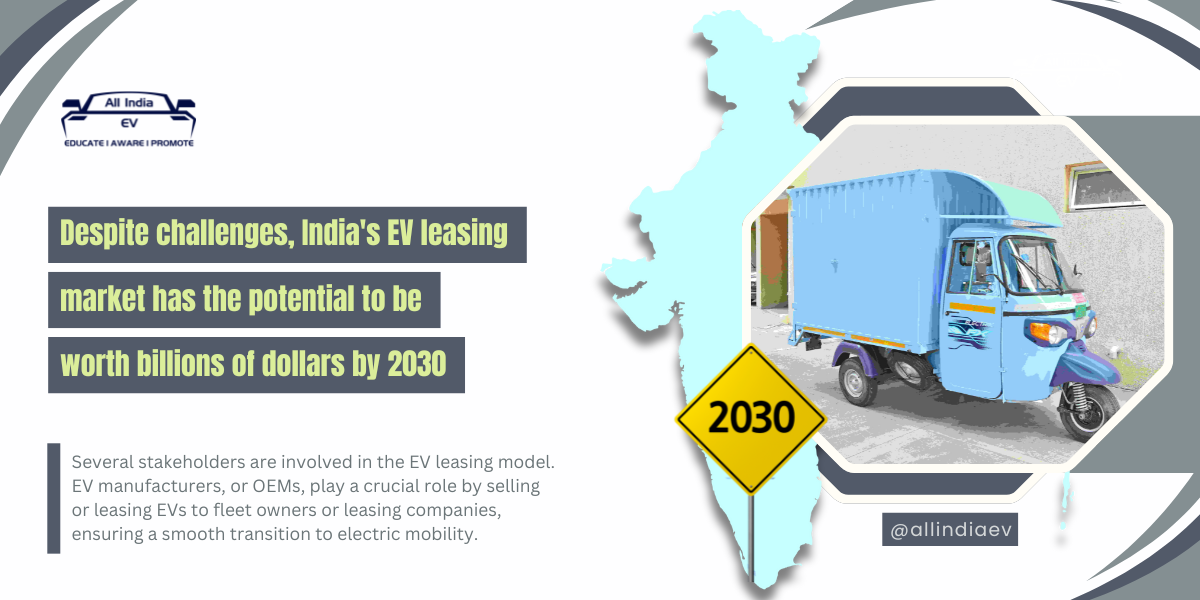
The Indian electric vehicle (EV) leasing market is on the brink of a major expansion. Currently valued at around USD 170 million, it’s projected to skyrocket to USD 4-5 billion by FY30, fueled by a staggering compound annual growth rate (CAGR) of 73%. Commercial vehicles (CVs) are expected to play a pivotal role in driving this surge, accounting for the lion’s share of the leasing opportunity.

EV Leasing: A Complex Ecosystem

Q: What are the key components in the EV leasing model?

A: The industry of the EV leasing model encompasses many interconnected entities. The OEMs develop electric vehicles, and manufacturers either sell or lease the vehicles to fleet operators or leasing companies. The fleet owners or leasing companies purchase the EVs from OEMs and in turn lease them to electric vechicle fleet operators, the end-use customer. The end-use customer can be assistance companies for transportation, e.g. logistics and ride-hailing, corporate commuting companies, or individual customers purchasing for their own use. These end-use companies use the electric vechicle in their fleet or operations. Other industries that support the logistics or transportation sectors can also utilize leased EVs for transportation or use as part of a service.

Q: What are the major challenges that are stopping the growth of the leasing market?

A: While the leasing electric vechicle market is poised to take-off, the leasing market faces several critical challenges. The cost for an electric vehicle is still so high that leasing will have a higher monthly rate compared to a gas vehicle, thus making it difficult for the leasing company to remain competitive. Uncertainty with the resale value in the market is still an issue used by the lessee to determine if they will lease an EV or not, due to limited lease history, rapid technological advancements of vehicles higher resale values over time, and tax advantages decreasing faster than potential problems at the end of the lease terms.

Q: How can these challenge be addressed to help facilitate and improve the leasing market?

More EV News

IIT Kharagpur Partners with Universe Mobility: Full Details Inside
Battery Operated Electric Vehicles (BEVs): An In-Depth Overview
GST on Electric Vehicles (EVs): Latest Rates and Impact
JBM Introduces 200 Ecolife Electric Buses in Odisha, Expanding Its Presence to Eastern India
Top 5 New Electric Bikes in India 2024-25

A: In order to mitigate and facilitate the hiccups that will expand the electric vechicle leasing market, stakeholders must find ways to work together. Government incentives can help subsidize the costs of electric vechicle leases by providing tax breaks or other investments. Continued research and development of battery chemistry and charging infrastructure will also be a big player in the decrease in overall vehicle costs in the market and provide better resale value as well.

EV Leasing: A Growing Market

Q: What are leasing companies doing regarding the leasing market issues?

A: While the EV leasing market is experiencing some challenges due to upfront costs, the leasing companies are hard at work finding ways to address these challenges. By signing exclusive electric vechicle procurement agreements with OEMs and leveraging incentives, including tax breaks and other government incentives, leasing companies can pass along a lower price to effectively compete. Furthermore, bundled services for charging, service and maintenance all in one place could alleviate some of the operational costs for drivers while lowering their contractual cost. The current focus on sustainability paired with increasing opportunities for corporate fleet offerings has value as businesses hope to reduce carbon emissions.

Q: What is the outlook for financing in the market?

A: The outlook is also very positive for financing EVs. The total disbursed loan value for EVs was USD 2 billion in FY24 and with the increase in electric vechicle adoption is expected to reach USD 31 billion in FY30. The financing penetration for E2Ws was about 40% in FY24 with an LTV cycle at 70% and is expected to reach 55% and 80%, respectively, by FY30. The finance penetration for E4Ws is projected to reach 80% by FY30 compared to the FY24 level of 70%. In the electric CV space the financing penetration is expected to reach 95% by FY30. This data suggests more financing options available to EV buyers.

EV Financing: A Changing Landscape

Q: What is the difference in financing parameters between EVs and ICE vehicles?

A: Financing parameters, such as interest rates and loan tenures, differ between electric vehicles and internal combustion engine vehicles (ICE). For instance, banks typically charge about 0.5% lower interest rate to E2W buyers compared to ICE two-wheelers. Meanwhile, commercial electric vehicles generally receive interest rates around 1-7% higher than ICE vehicles. Electric vechicle customers will also be tasked with shorter loan tenures, higher interest rates, lower Loan-to-Values (LTVs) – in addition to incurring a battery replacement cost.

Q: What do financiers find challenging in financing EVs?

A: Financiers also find it challenging to finance EVs – a concern raised in the Praxis Global EV Report. An immature resale market and uncertainty about the value and degradation of batteries is risky for financiers in this sector. In response, financiers typically mitigate these risks with low LTVs, high interest rates, and shorter loan tenures. As electric vechicle adoption rises and financiers accumulate more data about electric vechicle behavior, they are expected to relax these measures and start offering loans under similar terms associated with ICE vehicles. Financiers may also use data gathered around vehicle usage, battery health and rider behavior to better understand risk and improve lending decisions.
Join All India EV Community

Click here for more such EV Updates

Technical Analysis: Hub Motors vs. Mid-Drive Motors in Electric Vehicles
OHM Automotive joins hands with KINWIN and CHTC to introduce CATL battery-powered electric buses in India
Octillion Power Systems India Division Surpasses 100,000 EV Battery System Milestone Across its Local Manufacturing Facilities
4 EV Infrastructure Stocks Powering India’s Electric Mobility Growth
From BaaS to BaaB: A Paradigm Shift in EV Ownership
TAGGED:EVEV Leasing MarketEV Market

Sign Up For Daily Newsletter

Be keep up! Get the latest breaking news delivered straight to your inbox.
Loading
By signing up, you agree to our Terms of Use and acknowledge the data practices in our Privacy Policy. You may unsubscribe at any time.
Share This Article
Facebook Whatsapp Whatsapp LinkedIn Copy Link Print
Leave a Comment

Leave a Reply Cancel reply

Your email address will not be published. Required fields are marked *

Follow US
XFollow
InstagramFollow
YoutubeSubscribe
LinkedInFollow
What: India’s finance ministry has directed public sector banks, insurers, and financial institutions to reduce operational spending and accelerate adoption of electric vehicles across official fleets. The move is part of a wider austerity push linked to rising global economic uncertainty and fuel-related risks. The Number: The directive impacts major public institutions including State Bank of India, Bank of Baroda, and Life Insurance Corporation of India, covering millions of employees and thousands of operational vehicles nationwide. The Impact: The policy signals a new phase of institutional fleet electrification in India, where EV adoption is now being tied directly to fiscal discipline, fuel import management, and public-sector operational efficiency. The Core News India’s finance ministry has formally instructed state-run financial institutions to implement strict expenditure controls while simultaneously accelerating EV adoption for official transport operations. The directive from the Department of Financial Services asks organisations to replace petrol and diesel vehicles used at head offices and branch operations with electric vehicles “as far as possible.” The order comes amid growing concern over the economic impact of prolonged geopolitical instability in West Asia, which threatens to increase crude oil prices, widen India’s import bill, and pressure the rupee. Alongside the EV transition mandate, the government has also pushed virtual meetings, reduced foreign travel, and tighter administrative spending controls across public-sector institutions. For India’s EV ecosystem, the directive is strategically important because it expands demand visibility beyond state transport undertakings and government departments into the financial sector itself. PSU banks and insurers operate one of the country’s largest distributed office networks, including regional offices, branch fleets, field operations, and administrative mobility services. Even a phased transition could create a sizeable procurement pipeline for electric passenger vehicles, charging infrastructure providers, and fleet management companies. Breaking Down the Update • The Department of Financial Services issued the austerity and EV adoption directive to PSU banks, insurers, and financial institutions. • The government wants petrol and diesel vehicles used in official operations to be progressively replaced by EVs wherever operationally feasible. • The policy push follows Prime Minister Narendra Modi’s appeal for fuel conservation and controlled discretionary spending amid global energy uncertainty. • The directive also mandates greater use of video conferencing to reduce travel-related operational expenditure. • The move could indirectly support domestic EV OEMs, leasing firms, and charging infrastructure operators through institutional procurement demand. • The banking and insurance sector may emerge as a new enterprise fleet electrification category in India’s EV transition roadmap. How PSU banks EV adoption will help Indian EV Market The expansion of PSU banks EV adoption could create a strong institutional demand layer for India’s electric mobility sector. Public sector banks and insurers operate thousands of branch offices across urban, semi-urban, and rural India. Their transition to EV fleets can generate predictable procurement volumes for domestic automakers, especially in the electric sedan, compact SUV, and commercial mobility segments. Beyond vehicle sales, the policy may also accelerate deployment of workplace charging infrastructure at bank headquarters, zonal offices, and regional branches. This can support charger utilisation economics while helping normalise EV infrastructure in tier-2 and tier-3 cities. Another important impact is signalling. When large state-linked financial institutions adopt EVs as operational assets rather than pilot projects, it improves confidence across the broader enterprise mobility market. Private banks, NBFCs, and insurance firms could eventually follow similar fleet transition models to reduce long-term fuel and maintenance costs. PSU banks EV adoption also aligns with India’s larger energy security strategy. Lower petroleum consumption in institutional fleets directly supports efforts to reduce crude import dependence while stabilising operational expenditure during periods of volatile global oil prices. Conclusion & Next Steps The government’s push toward PSU banks EV adoption reflects a broader shift where EV deployment is increasingly being linked with macroeconomic resilience rather than only sustainability targets. Execution, however, will depend on procurement timelines, charging infrastructure readiness, and operational suitability across
India directs state-run banks, insurance firms to cut costs, shift to EVs
20 May 2026
Uttar Pradesh To Get 714 New EV Charging Stations Under Centre’s Rs 500 Crore Infrastructure Push
20 May 2026
China’s EV slowdown could trigger the industry’s biggest global reset
20 May 2026
All India EV: Edition 49
What all happened in April 2026?
Click Here
All India EV

Daily EV Industry updates for you…

Categories

  • EV News
  • EV Launch
  • Investments & Funding
  • Market Insights
  • Guest Articles
  • EV Engineering

Quick Links

  • Community
  • Content Services
  • Branding Services
  • My EV Charger
  • Substack

© Developed and Managed by “The Energy Log”

Welcome Back!

Sign in to your account

Username or Email Address
Password

Lost your password?

Not a member? Sign Up