


India Electric Mobility Index to Highlight States Leading in EV Adoption and Identify Areas Needing Improvement for Faster Transition
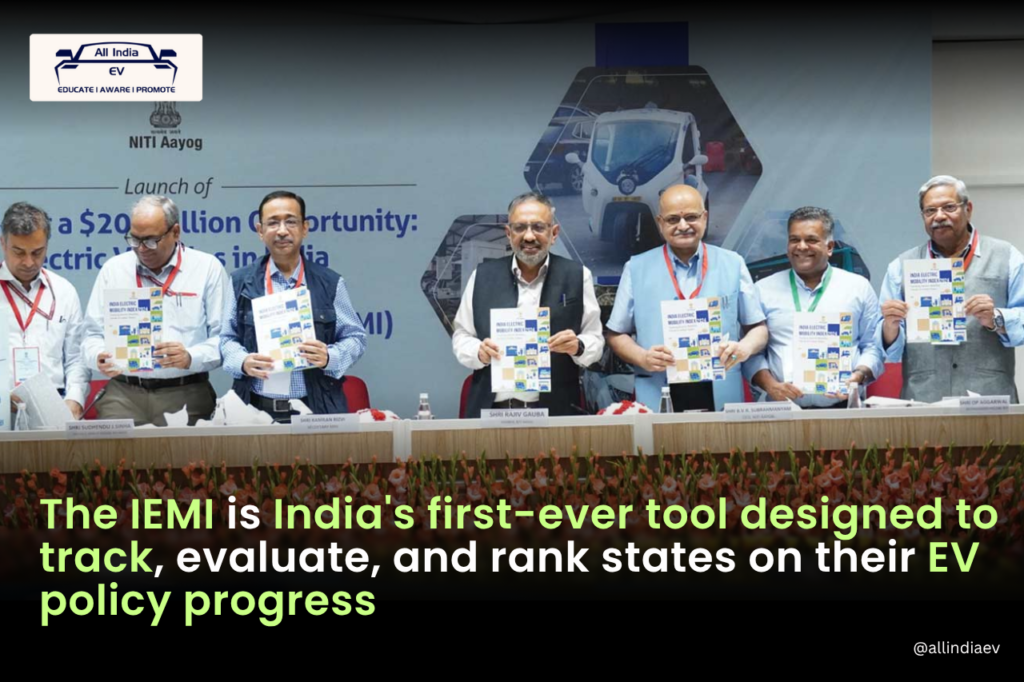
In a landmark move to accelerate India’s transition toward sustainable transport, NITI Aayog has unveiled the India Electric Mobility Index (IEMI) — the country’s first comprehensive tool to track and evaluate electric mobility performance across all states and union territories. The IEMI aims to foster healthy competition, encourage policy innovation, and ensure coordinated progress toward India’s net-zero emissions target by 2070.
Government Offers States Lucrative Incentives to Accelerate Nationwide EV Charging Network
A Major Step in India’s EV Evolution
As India intensifies its efforts to reduce carbon emissions from the transport sector, both central and state governments are working in tandem to strengthen EV infrastructure, manufacturing, and adoption. The launch of IEMI marks a historic step, as it provides a standardized and data-driven framework for evaluating state-level electric mobility initiatives.
“The India Electric Mobility Index (IEMI) will not only help states assess their EV progress but will also promote knowledge sharing and healthy competition,” a senior NITI Aayog official said.
What is the India Electric Mobility Index (IEMI)?
Developed by NITI Aayog, the India Electric Mobility Index evaluates each state and union territory based on their progress in EV adoption, charging infrastructure readiness, and research and innovation.
The index revolves around three key themes:
More EV News
- Transport Electrification: Measures the pace of electric vehicle adoption across categories — two-wheelers, three-wheelers, four-wheelers, and buses.
- Charging Infrastructure Readiness: Evaluates the availability of charging stations, battery-swapping facilities, and enabling regulatory frameworks.
- EV Research and Innovation: Assesses EV manufacturing capacity, R&D activities, and local supply chain development.
Each state will be scored out of 100 points, based on 16 key indicators across these three themes.
Why IEMI Was Needed
While India’s EV landscape has grown rapidly, progress has varied widely across regions. Central schemes like FAME, PLI, and the National EV Policy have driven national momentum, but implementation at the state level remains uneven.
States differ in their infrastructure quality, electricity access, investor confidence, and public awareness. To bridge these gaps, a scientific and transparent evaluation system like IEMI was essential.
IEMI provides that framework — enabling states to identify strengths, pinpoint weaknesses, and align their actions with national EV goals.
How IEMI Will Help States
The India Electric Mobility Index is designed as a policy-enabling tool, not merely a ranking system. Its impact will be both practical and strategic:
- Supports better policymaking: By showing measurable outcomes of existing EV initiatives.
- Encourages competition: States will strive to improve their rankings, driving faster implementation.
- Promotes collaboration: Leading states can serve as mentors or models for others, helping replicate best practices.
- Aligns with national sustainability goals: Ensures all states contribute cohesively toward India’s net-zero emission target.
“The IEMI acts like a mirror for states — helping them understand where they stand and how far they can go,” said an energy policy analyst at NITI Aayog.
The Role of States in India’s EV Growth
While central policies set the direction, state governments play the most crucial role in execution. They manage:
- Tax incentives and registration benefits for EV buyers.
- Public transport electrification and local charging networks.
- Urban planning and power distribution for charging stations.
States that adopt proactive EV policies — such as Delhi, Maharashtra, Karnataka, and Tamil Nadu — have already attracted significant investment and achieved higher EV adoption rates. The IEMI will now make such progress measurable and replicable nationwide.
Expected Impact of IEMI
The launch of the India Electric Mobility Index is expected to reshape India’s EV landscape in multiple ways:
- Boosting EV ecosystem development: Strengthening local manufacturing, battery innovation, and charging networks.
- Attracting new investments: States with better scores will emerge as preferred destinations for global and domestic EV players.
- Creating green jobs: Expanding opportunities in battery technology, software development, charging infrastructure, and vehicle maintenance.
- Reducing pollution: Accelerating EV adoption will help cut carbon emissions and urban air pollution, improving public health.
Importantly, the IEMI is designed as a dynamic and evolving tool — it will be updated regularly to reflect advances in EV technology, market adoption, and policy reforms.
A Roadmap for Sustainable Mobility
The India Electric Mobility Index (IEMI) goes beyond being a performance scorecard — it is a roadmap for India’s EV transformation. By promoting accountability, innovation, and collaboration, it will help ensure that India’s transition to electric mobility remains inclusive, competitive, and sustainable.
Comment by Author
The launch of IEMI represents a pivotal moment in India’s EV journey. For the first time, states will compete not just for economic growth but for environmental leadership.
This initiative empowers regional governments to take ownership of India’s clean mobility transition while aligning with national climate goals. As data-driven insights fuel policy innovation, the India Electric Mobility Index will serve as both a mirror and a motivator — guiding India toward a cleaner, greener, and more equitable transport future.