


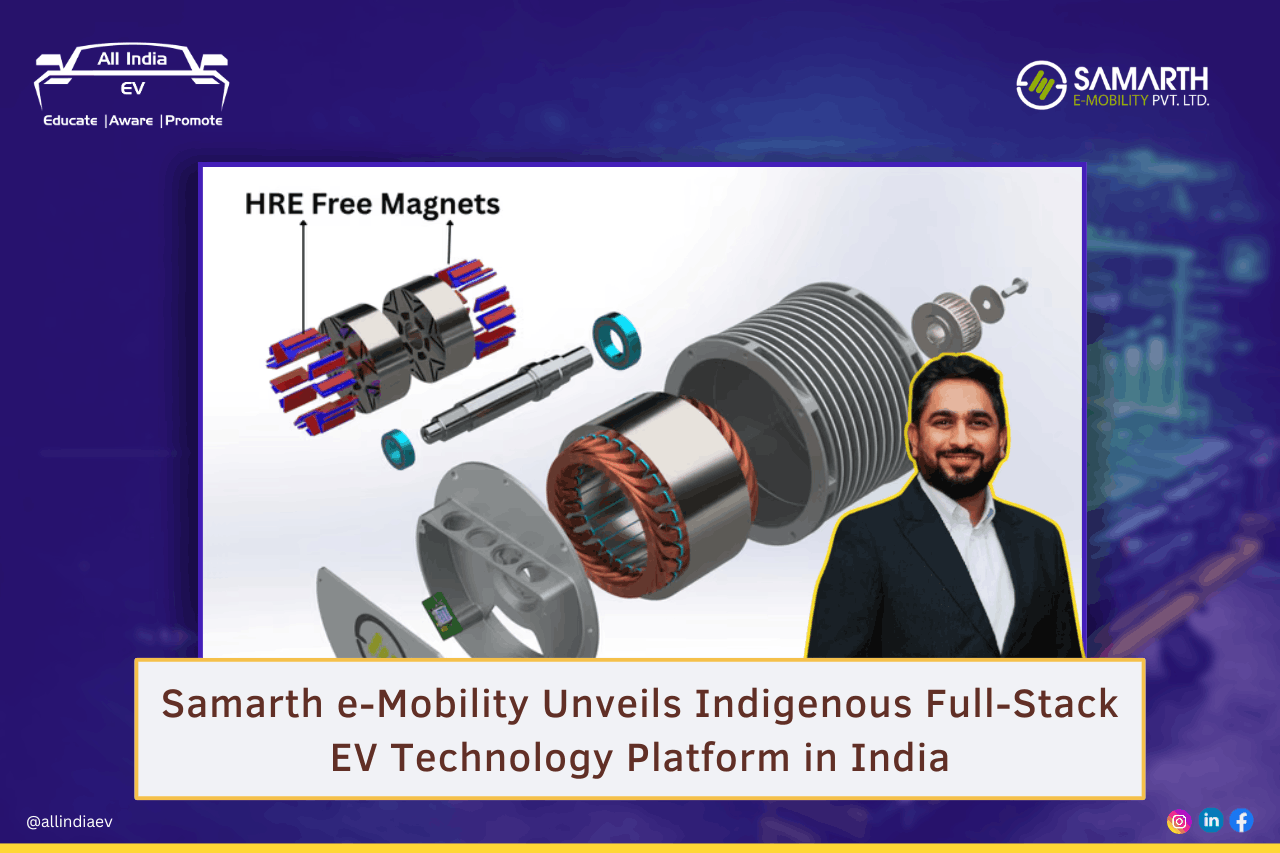
Samarth E-Mobility develops indigenous full-stack EV technology platform, signalling a deeper push toward homegrown EV engineering at a time when India is trying to localise more of its electric mobility value chain. The company said the platform was developed at its Kalol, Gujarat R&D centre and brings together several key EV systems under one in-house architecture, including the battery pack, battery management system, motor, motor controller, and power electronics.
Beyond the core propulsion stack, the platform also includes an AI-controlled onboard fast charger with ~1500W charging capacity, a DC-DC converter, an instrument cluster, and a proprietary operating system. That matters because the real value of a full-stack EV platform is not just in making components locally, but in controlling how those components talk to each other in real-world vehicle conditions.
Samarth said it has spent three years building this platform in-house, and that the system will power its upcoming electric motorcycle. The company added that its battery pack has been tested and homologated by NATRAX, while the in-house BMS has been validated by ICAT. It also claimed the technology has undergone more than 51,000 km of real-world riding tests, along with durability and dynamometer testing.
On the manufacturing side, Samarth E-Mobility said it operates a facility in Chhatral, Gujarat, with a monthly production capacity of more than 45,000 electric two-wheelers. The company plans to launch its first electric motorcycle in India later this year, positioning the platform as the technological base for its entry into the premium aspirational segment.
From an All India EV perspective, this is more than a startup technology announcement. It reflects a wider trend in the market: EV companies are increasingly realising that long-term competitiveness will depend not only on assembling vehicles, but on owning the intelligence layer across batteries, controls, software, and charging systems.
How This Will Help the Indian EV Market
This development matters because it addresses one of the most important structural gaps in India’s EV ecosystem: technology dependence. A large part of the EV industry still relies on imported subsystems or semi-integrated kits, especially in areas such as motors, controllers, BMS software, and power electronics. When a company claims to build a full-stack platform locally, it suggests India is slowly moving from EV assembly toward EV engineering.
More EV News
That shift can help the market in three ways. First, tighter in-house integration can improve vehicle efficiency, reliability, and diagnostics because the hardware and software are designed to work together from day one. Second, deeper localisation can reduce supply-chain exposure over time, especially when global component markets become volatile. Third, it creates a stronger domestic knowledge base in exactly the areas where India wants to become more self-reliant: battery systems, embedded electronics, control software, and powertrain integration.
There is also a commercial angle. If such platforms prove reliable in the field, Indian EV makers may be able to improve margins, respond faster to market needs, and build more differentiated products instead of competing only on price. In plain terms, this is the kind of groundwork that can help India build not just more EVs, but better EV companies.