


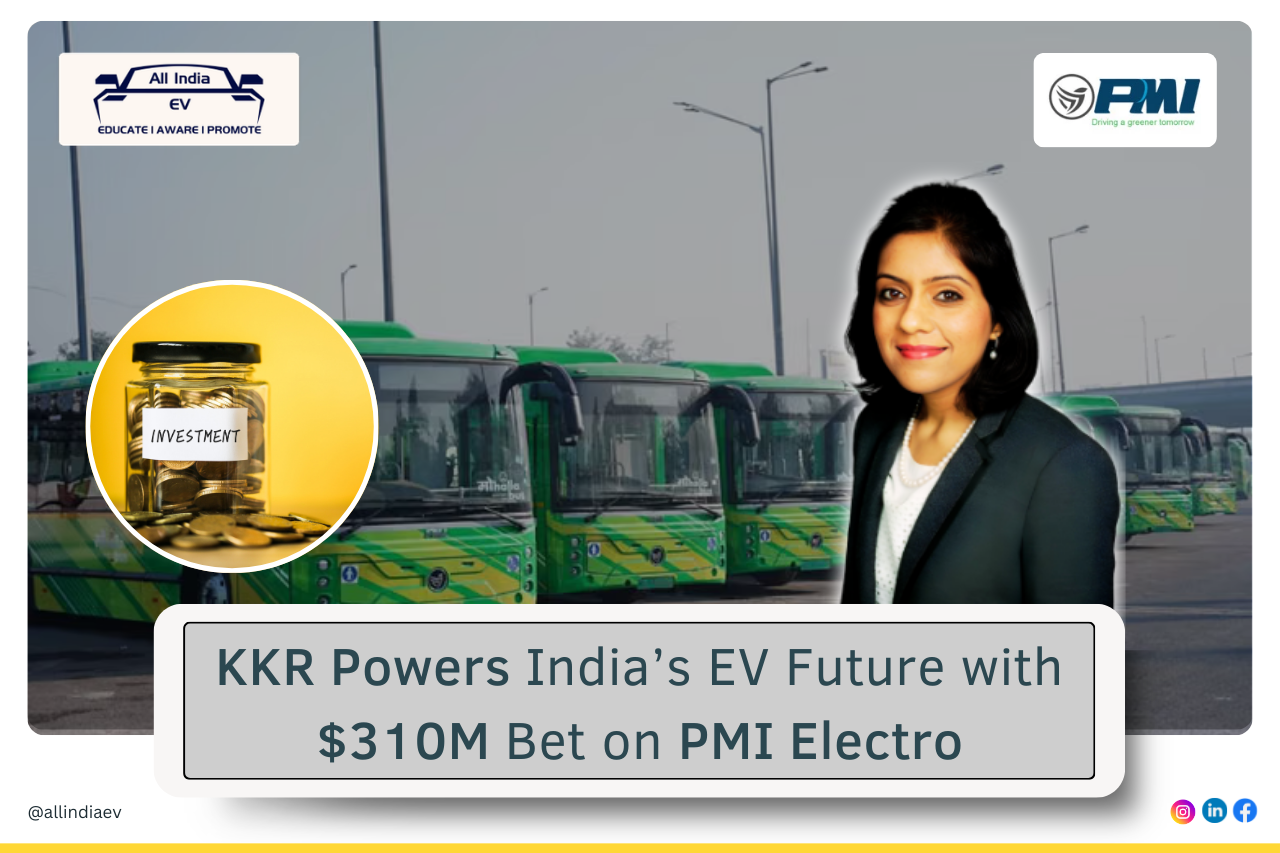
What: Global investment firm KKR will invest $310 million in PMI Electro and acquire a majority stake in Allfleet to support electric bus expansion in India.
The Number: The investment size is $310 million, while Allfleet is targeting a fleet of over 5,000 electric buses under agreements with state transport authorities in multiple Indian cities.
The Impact: This is KKR’s first Global Climate Transition investment in India, and it signals rising institutional confidence in India’s electric public mobility sector.

The Core News
Global investment firm KKR has announced plans to invest $310 million in PMI Electro as it looks to deepen its presence in India’s clean mobility ecosystem. As part of the transaction, KKR will take a majority stake in Allfleet and a minority stake in PMI Electro, the electric commercial vehicle manufacturer.
The development is significant because it brings large-scale institutional capital into India’s electric bus segment, a space that needs patient funding, manufacturing discipline, and execution strength. KKR said the investment will help expand Allfleet’s electric bus platform while also strengthening PMI Electro’s manufacturing capabilities.
Allfleet, founded in 2022, focuses on deploying and operating electric buses for public transport systems. The company is targeting a fleet of more than 5,000 e-buses through agreements with state transport authorities across multiple Indian cities. The transaction is subject to regulatory approvals and is expected to close by mid-2026.
Breaking Down the Update
- Capital infusion: KKR is putting $310 million into PMI Electro to support growth in the electric bus platform.
- Ownership structure: KKR will acquire a majority stake in Allfleet and a minority stake in PMI Electro.
- Market focus: The investment is aimed at electric bus deployment and public transport operations in Indian cities.
- Manufacturing angle: PMI Electro’s manufacturing capability is expected to get stronger with this transaction.
- Deployment scale: Allfleet is targeting 5,000+ e-buses under state transport agreements.
- Strategic significance: This is KKR’s first Global Climate Transition investment in India.
- Timeline: The deal is expected to close by mid-2026, subject to approvals.
How this will help Indian EV Market
This development matters because electric buses are one of the few EV segments where scale can transform the market structurally, not just symbolically. When a global investor like KKR commits $310 million to a platform connected to manufacturing and fleet deployment, it sends a strong signal to the broader market that India’s e-bus business is maturing into an investable category.
More EV News
For the Indian EV ecosystem, the impact goes beyond one company. Electric bus deployment creates demand for a full chain of services and products: battery systems, charging infrastructure, depot design, fleet software, AMC support, power management, and financing models. In simple words, one e-bus order does not only help the OEM, it energises the entire backend ecosystem.
This is especially important for India because public transport electrification offers high daily vehicle utilization, visible urban impact, and stronger fuel substitution than many small fragmented EV pilots. If Allfleet moves meaningfully toward its 5,000+ bus target, it can accelerate local supply chains, improve service capability, and push more state transport undertakings to take electrification seriously.
It also strengthens the case that India’s EV transition cannot depend only on electric two-wheelers and passenger vehicles. Commercial and public mobility will be one of the real engines of scale. This deal, therefore, is not just about funding. It is about confidence, execution, and building a larger operating base for India’s electric mobility future.
Conclusion & Next Steps
The KKR-PMI Electro-Allfleet transaction is more than a financial headline. It reflects growing belief that India’s electric bus opportunity is large enough for global capital, structured enough for institutional participation, and important enough to shape the next phase of the EV market. The next thing to watch will be execution: fleet rollout, manufacturing scale-up, and how quickly these buses move from agreements to roads.’s electric bus market is becoming investable, operationally scalable, and structurally important.
Catch up on All India EV’s related coverage on India’s evolving commercial EV subsidies and battery swapping policies at All India EV