


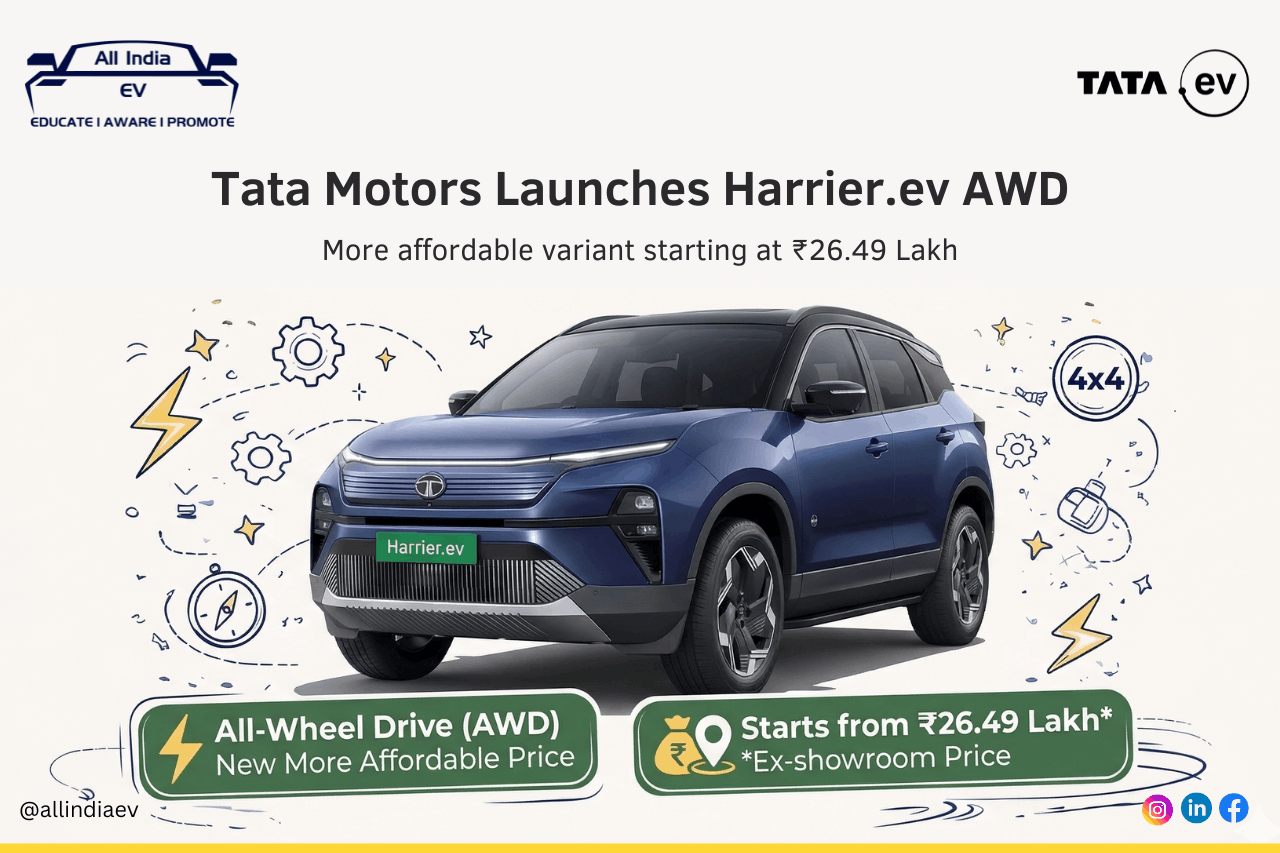
What: Tata Motors has added a new Fearless+ QWD 75 variant to the Harrier.ev lineup, bringing all-wheel-drive capability to a lower price point.
The Number: The new variant is priced at ₹26.49 lakh ex-showroom, while the wider Harrier.ev range now spans ₹21.49 lakh to ₹28.99 lakh.
The Impact: Tata is trying to make a more performance-oriented electric SUV configuration accessible to a broader set of buyers, especially those looking for AWD, stronger torque, and terrain-focused capability in the EV segment.
The Core News
Tata Motors Passenger Vehicles has expanded the Harrier.ev portfolio with the launch of the Fearless+ QWD 75 persona at ₹26.49 lakh (ex-showroom). The newly introduced version brings quad-wheel-drive / all-wheel-drive capability into a relatively lower pricing band within the Harrier.ev range.
According to ETAuto, the variant is built on Tata’s EV architecture and delivers 504 Nm of torque, with a claimed 0 to 100 kmph time of 6.3 seconds. Tata has positioned the model as a more accessible entry point for buyers who want a high-performance electric SUV with stronger capability credentials.
The SUV also comes with six terrain modes, off-road assist, and boost mode, along with features such as a 360-degree camera, powered and ventilated front seats, dual-zone climate control, and a 10-speaker audio system. Tata has also introduced a new exterior colour option, Seaweed Green, across the Harrier.ev lineup.
Breaking Down the Update
- New variant added: Tata has launched the Fearless+ QWD 75 variant in the Harrier.ev portfolio.
- Price point: The variant is priced at ₹26.49 lakh ex-showroom.
- AWD access: The new model brings all-wheel-drive capability to a lower band within the Harrier.ev range.
- Performance specs: It offers 504 Nm torque and a claimed 0-100 kmph acceleration in 6.3 seconds.
- Capability angle: Tata has included six terrain modes, off-road assist, and boost mode.
- Feature package: The SUV includes a 360-degree camera, powered and ventilated front seats, dual-zone climate control, and a 10-speaker audio system.
- Range pricing: The full Harrier.ev lineup now runs from ₹21.49 lakh to ₹28.99 lakh.
- Extra cost note: Tata has said the listed prices exclude charger and installation costs, while an AC fast charger costs an additional ₹49,000.
How this will help Indian EV Market
This update matters because it shows that the Indian EV passenger vehicle market is slowly moving beyond the basic affordability-versus-range conversation and entering a more layered product phase. When an automaker introduces a more affordable AWD electric SUV variant, it expands the market conversation from just “Can EVs replace ICE cars?” to “Can EVs also deliver performance, terrain capability, and premium utility at different price points?” That shift is important for category maturity.
More EV News

For the Indian EV market, this helps in three ways. First, it widens consumer perception. EVs are still often seen as urban commuter products, but a product like the Harrier.ev in a lower-priced AWD trim pushes the idea that electric SUVs can also serve aspirational, capability-focused buyers. Second, it sharpens competition. More feature-rich variants at relatively more accessible prices can pressure the market to improve value delivery, not just headline pricing. Third, it supports premium EV adoption, which is crucial because higher-end products often help normalize new technologies faster.
In practical terms, India’s EV ecosystem needs not only mass-market cars but also stronger flagship and upper-mid segment products that make electric mobility feel complete. Variants like this can help build buyer confidence around EV performance, product diversity, and technological depth, which eventually supports broader market adoption.
Conclusion & Next Steps
Tata’s latest Harrier.ev move is not just about adding another trim. It is about widening the appeal of electric SUVs by bringing AWD capability, strong torque, and terrain-oriented features to a more accessible price bracket within the lineup. The next thing to watch will be how buyers respond to this value positioning and whether more OEMs start using feature-led differentiation to push EV adoption in the premium SUV space.
Catch up on All India EV’s related coverage on India’s evolving commercial EV subsidies and battery swapping policies at All India EV