
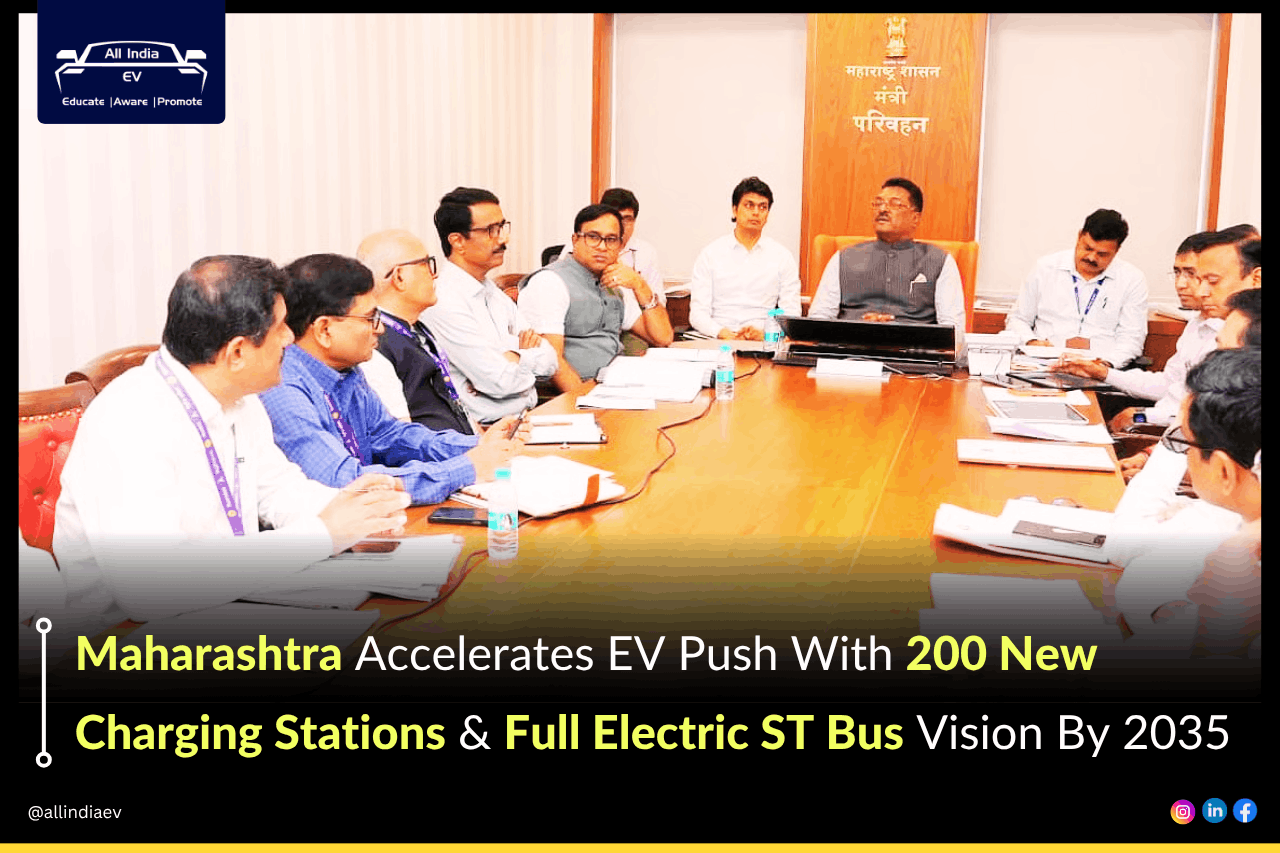

What: Maharashtra is planning to develop around 200 EV charging stations under the public-private partnership (PPP) model to support the state-wide electrification of the Maharashtra State Road Transport Corporation (MSRTC) bus fleet by 2035. The project will use MSRTC land parcels for charger deployment and commercial EV charging operations.
The Number: The state is targeting support infrastructure for nearly 20,000 electric buses, while allocating around 1,500 square feet of land per charging location for private operators under the PPP structure.
The Impact: The Maharashtra EV charging stations PPP model could become one of India’s largest state-backed public transport electrification infrastructure programs. It also signals a shift toward commercially viable charging networks integrated with public bus depots and mixed-use EV charging demand.

The Core News
The Maharashtra government is accelerating its electric public transport roadmap through a large-scale charging infrastructure push linked directly to MSRTC’s fleet electrification targets. Transport Minister Pratap Saraki confirmed that nearly 200 EV charging stations will be developed across the state under a PPP framework, with the long-term objective of converting the entire ST bus fleet into electric buses by 2035.
Under the proposed structure, private developers will be allowed to build and operate charging hubs on MSRTC-owned land parcels. The model is designed to reduce upfront capital pressure on the state transport undertaking while simultaneously creating commercial utilisation opportunities for charging operators. Developers will also be permitted to offer charging services to private EV users during non-peak operational hours for ST buses, improving charger utilisation economics.
The move comes as MSRTC scales up its electric bus procurement pipeline. Current infrastructure remains significantly below projected demand, with only a limited number of charging stations operational against future requirements running into thousands of chargers. State officials estimate the transport corporation will require extensive depot electrification, grid readiness upgrades, and private-sector participation to support large-scale fleet transition over the next decade. Tendering activity for the first phase is expected to begin shortly.
More EV News

Breaking Down the Update
• Maharashtra plans to establish around 200 EV charging stations across the state under a PPP structure
• The project is linked to MSRTC’s target of fully electrifying its bus fleet by 2035
• Private developers will receive designated MSRTC land parcels for charger installation and operations
• Operators can commercially serve private EV users during non-bus operational periods
• The state aims to support infrastructure demand for nearly 20,000 electric buses
• Tendering activity for the project is expected to begin within the next few weeks
• Current charging infrastructure remains insufficient relative to projected e-bus deployment targets
• The initiative could improve revenue generation for MSRTC through lease rentals and profit-sharing mechanisms
How Maharashtra EV charging stations PPP model will help Indian EV Market
The Maharashtra EV charging stations PPP model represents an important shift in how large-scale EV infrastructure may be deployed in India’s public transport ecosystem. Instead of depending entirely on state-funded infrastructure, the model introduces private capital participation while leveraging government-owned transport land assets.
This structure could reduce capital burden on state transport undertakings that are already financially stressed while improving charging network expansion speed. Since public bus depots are usually strategically located across urban and semi-urban routes, these charging stations can also strengthen charging accessibility for private EV users beyond metropolitan cities.
The commercial flexibility being offered to charging operators is another important development. Allowing operators to utilise idle charging capacity for private EVs improves infrastructure utilisation rates, which remains one of the biggest financial challenges for India’s charging industry today.
For India’s electric bus market, the model creates long-term visibility for charger demand, grid upgrades, and fleet electrification planning. It may also encourage other state transport corporations to adopt similar land-leasing and PPP frameworks for EV infrastructure deployment.
If executed efficiently, the Maharashtra EV charging stations PPP model could become a scalable template for state-led EV charging expansion across India’s public mobility sector.
Way forward ..
The Maharashtra EV charging stations PPP model reflects a more commercially structured approach to public transport electrification rather than a purely subsidy-driven rollout. The next phase will depend heavily on private-sector participation, execution timelines, power infrastructure readiness, and charger utilisation economics. As MSRTC expands its electric bus fleet over the next few years, the effectiveness of this charging deployment strategy will become a key benchmark for other Indian states exploring large-scale e-bus transition programs.
Read More: Catch up on All India EV’s related coverage on India’s evolving commercial EV subsidies and battery swapping policies at All India EV