
All India EVAll India EVAll India EV
Notification
Font ResizerAa
  • Home
  • EV News
  • EV Launch
  • Market Insights
  • Investments & Funding
  • Guest Articles
  • EV Engineering
  • Contact
Reading: Srivaru’s PRANA 2.0 Electric Motorcycle at INR 2.55 Lakhs
Share
All India EVAll India EV
Font ResizerAa
  • Home
  • EV News
  • EV Launch
  • Market Insights
  • Guest Articles
  • EV Engineering
  • Contact
Search
  • Home
    • Home 1
    • Home 2
    • Home 3
    • Home 4
    • Home 5
  • Home
  • Categories
    • Electric
  • Categories
  • Shows
    • Rap
  • More Foxiz
    • Blog Index
    • Contact
  • Bookmarks
    • Customize Interests
    • My Bookmarks
  • More Foxiz
    • Blog Index
    • Sitemap
Have an existing account? Sign In
Follow US
Srivaru's PRANA 2.0 Electric Motorcycle at INR 2.55 Lakhs
Home » Blog » Srivaru’s PRANA 2.0 Electric Motorcycle at INR 2.55 Lakhs
EV Launch

Srivaru’s PRANA 2.0 Electric Motorcycle at INR 2.55 Lakhs

Ankit Sharma
By
Ankit Sharma
ByAnkit Sharma
Follow:
Last updated: 26 August 2024
Share
4 Min Read
SHARE
Srivaru's PRANA 2.0 Electric Motorcycle at INR 2.55 Lakhs

Srivaru’s PRANA 2.0 Electric Motorcycle at INR 2.55 Lakhs

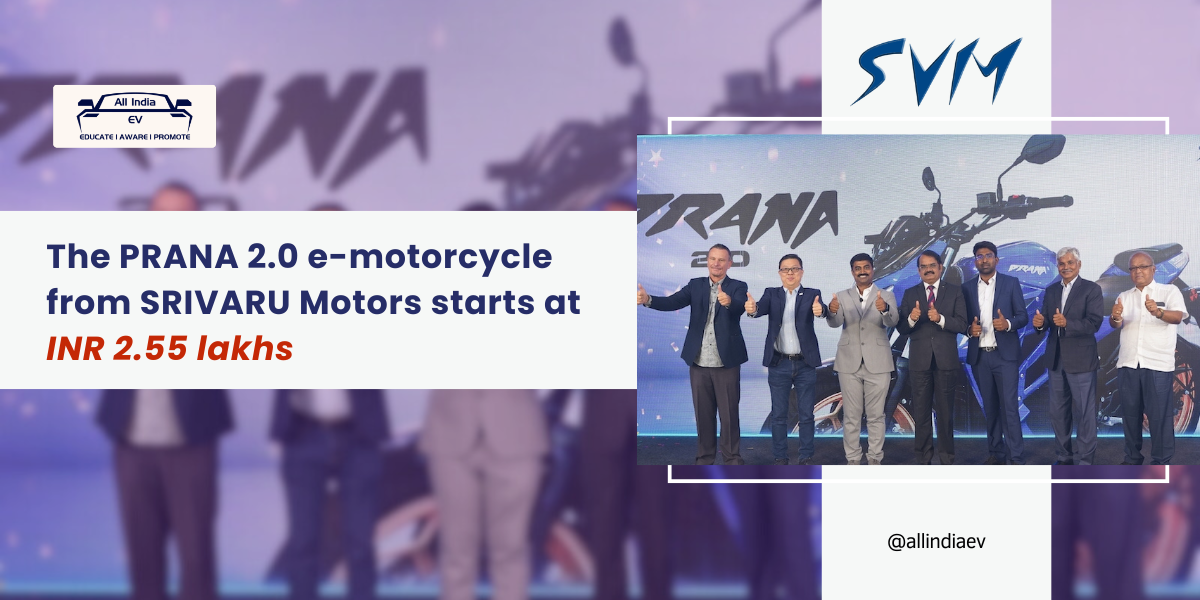
Nasdaq-listed Srivaru Motors, through the ticker “SVMH,” has announced its new electric two-wheeler, and this time it’s going to be an electric motorcycle priced at INR 2,55,150: the PRANA 2.0. The Founder and CEO of Srivaru Motors, Mohanraj Ramasamy, launched the PRANA 2.0.

Contents
  • Srivaru Motors Eyes Huge Potential in Indian EV Market
  • Srivaru Motors Expands Production Capacity
  • PRANA 2.0: A Feature-Packed Electric Motorcycle

Hourglass has just released two versions of the PRANA 2.0—the Grand and the Elite—begging interested customers to expect to begin receiving at the end of August 2024.

Srivaru Motors Eyes Huge Potential in Indian EV Market

Mohanraj Ramasamy, the Founder and CEO of Srivaru Motors, highlighted the potential in the Indian electric vehicle market as a whole, and particularly in Tamil Nadu, is huge. While elaborating on the same point, he mentioned that Tamil Nadu constitutes over 40% of the country’s EV demand, making this State a very prime market for Srivaru Motors.

Ramasamy underlined that the fast-growing Indian motorcycle market reached revenues of over USD 25.6 billion in 2023. Industry outlooks further forecast this to increase to USD 36.1 billion by 2027. Since electric motorcycles are supposed to capture about a 50% market share by 2030, there is huge potential growth lying ahead for the EV sector.

Srivaru Motors Expands Production Capacity

Srivaru Motors has been fast pacing in the electric vehicle market. Their first facility in Coimbatore was commissioned in 2017; they now roll out the PRANA 2.0, which is their new version of the electric motorcycle. This new iteration includes more than 100 new parts, which were a continuous refinement because of the tests made in the last two years.

Its Coimbatore manufacturing facility is empowered with the capability to run a single production line of 2,000 units per month in a single shift. With state-of-the-art automated assembly and testing lines, Srivaru Motors is well-positioned to scale up production manifold to meet the rapidly growing demand for electric motorcycles.

Besides the manufacturing capability, Srivaru Motors is developing all electronics needed for PRANA 2.0 and future products with the help of iVP Semiconductor. This goes to show even more the kind of leadership taken by Srivaru Motors within the electric vehicle market.

More EV News

Greaves Unveils Eltra City: The New Electric 3-Wheeler for Passengers
Hero, Bajaj Set to Launch New Mass-Market Electric Two-Wheelers to Accelerate Affordable EV Adoption in India
TVS iQUBE Introduces New Electric Scooter Models in India, Prices Start at INR 94,999
Godawari Electric Motors Reveals the Exciting Eblu Feo X
Rolls Royce is going to officially launch its first EV in India on January 19, 2024

PRANA 2.0: A Feature-Packed Electric Motorcycle

The Features of the PRANA 2.0 include:

1. Impressive Performance: Accelerates from 0 to 60 km/h in under 4 seconds, reaches a top speed of 123 km/h, and offers a range of 250 km.

2. Powerful Battery: Equipped with a high-capacity LFP battery pack available in two capacities: 5.0 kWh (Grand) and 8.44 kWh (Elite). Charges from 0 to 100% in 8 hours.

3. Efficient Motor: Powered by a BLDC Motor for optimal performance and efficiency.

4. Advanced Technology: Features an air-cooled BLDC controller with an operating voltage range of 42-72 V DC.

Engineering Director of Srivaru Motors Yuvaraj Sankar said, “The battery pack of 46120 cells and four driving modes also provide different user ride experience concerning vehicle performance and peak torque, including a reverse mode that can help for easy assistance to park a vehicle. PRANA has several issued patents and implemented the best in-wheel motor using a detachable rim to make sure serviceability is always top of mind.
Join All India EV Community

Click here for more such EV Updates

UPCOMING Simple Dot One Electric Scooter Set to Launch on December 15
Statiq launches StatiqConnect to enhance EV charging experience
AutoNxt Automation Showcases 45HP Tractor at KISAN Expo
Kinetic E-Luna Debuts in India with an Introductory Price of ₹69,990
Tata’s “ACE EV” Globally Debuts with Launch in Nepal
TAGGED:ElectricPRANASrivaru

Sign Up For Daily Newsletter

Be keep up! Get the latest breaking news delivered straight to your inbox.
Loading
By signing up, you agree to our Terms of Use and acknowledge the data practices in our Privacy Policy. You may unsubscribe at any time.
Share This Article
Facebook Whatsapp Whatsapp LinkedIn Copy Link Print
Leave a Comment

Leave a Reply Cancel reply

Your email address will not be published. Required fields are marked *

Follow US
XFollow
InstagramFollow
YoutubeSubscribe
LinkedInFollow
Haryana cabinet approves new rules: No petrol, diesel vehicles for cab aggregators in NCR
21 May 2026
Ultraviolette and Bolt.Earth Expand Type-6 DC Fast Charging Infrastructure Across India
Ultraviolet and Bolt. Earth Expand Type-6 DC Fast Charging Infrastructure Across India
21 May 2026
What: India’s finance ministry has directed public sector banks, insurers, and financial institutions to reduce operational spending and accelerate adoption of electric vehicles across official fleets. The move is part of a wider austerity push linked to rising global economic uncertainty and fuel-related risks. The Number: The directive impacts major public institutions including State Bank of India, Bank of Baroda, and Life Insurance Corporation of India, covering millions of employees and thousands of operational vehicles nationwide. The Impact: The policy signals a new phase of institutional fleet electrification in India, where EV adoption is now being tied directly to fiscal discipline, fuel import management, and public-sector operational efficiency. The Core News India’s finance ministry has formally instructed state-run financial institutions to implement strict expenditure controls while simultaneously accelerating EV adoption for official transport operations. The directive from the Department of Financial Services asks organisations to replace petrol and diesel vehicles used at head offices and branch operations with electric vehicles “as far as possible.” The order comes amid growing concern over the economic impact of prolonged geopolitical instability in West Asia, which threatens to increase crude oil prices, widen India’s import bill, and pressure the rupee. Alongside the EV transition mandate, the government has also pushed virtual meetings, reduced foreign travel, and tighter administrative spending controls across public-sector institutions. For India’s EV ecosystem, the directive is strategically important because it expands demand visibility beyond state transport undertakings and government departments into the financial sector itself. PSU banks and insurers operate one of the country’s largest distributed office networks, including regional offices, branch fleets, field operations, and administrative mobility services. Even a phased transition could create a sizeable procurement pipeline for electric passenger vehicles, charging infrastructure providers, and fleet management companies. Breaking Down the Update • The Department of Financial Services issued the austerity and EV adoption directive to PSU banks, insurers, and financial institutions. • The government wants petrol and diesel vehicles used in official operations to be progressively replaced by EVs wherever operationally feasible. • The policy push follows Prime Minister Narendra Modi’s appeal for fuel conservation and controlled discretionary spending amid global energy uncertainty. • The directive also mandates greater use of video conferencing to reduce travel-related operational expenditure. • The move could indirectly support domestic EV OEMs, leasing firms, and charging infrastructure operators through institutional procurement demand. • The banking and insurance sector may emerge as a new enterprise fleet electrification category in India’s EV transition roadmap. How PSU banks EV adoption will help Indian EV Market The expansion of PSU banks EV adoption could create a strong institutional demand layer for India’s electric mobility sector. Public sector banks and insurers operate thousands of branch offices across urban, semi-urban, and rural India. Their transition to EV fleets can generate predictable procurement volumes for domestic automakers, especially in the electric sedan, compact SUV, and commercial mobility segments. Beyond vehicle sales, the policy may also accelerate deployment of workplace charging infrastructure at bank headquarters, zonal offices, and regional branches. This can support charger utilisation economics while helping normalise EV infrastructure in tier-2 and tier-3 cities. Another important impact is signalling. When large state-linked financial institutions adopt EVs as operational assets rather than pilot projects, it improves confidence across the broader enterprise mobility market. Private banks, NBFCs, and insurance firms could eventually follow similar fleet transition models to reduce long-term fuel and maintenance costs. PSU banks EV adoption also aligns with India’s larger energy security strategy. Lower petroleum consumption in institutional fleets directly supports efforts to reduce crude import dependence while stabilising operational expenditure during periods of volatile global oil prices. Conclusion & Next Steps The government’s push toward PSU banks EV adoption reflects a broader shift where EV deployment is increasingly being linked with macroeconomic resilience rather than only sustainability targets. Execution, however, will depend on procurement timelines, charging infrastructure readiness, and operational suitability across
India directs state-run banks, insurance firms to cut costs, shift to EVs
21 May 2026
All India EV: Edition 49
What all happened in April 2026?
Click Here
All India EV

Daily EV Industry updates for you…

Categories

  • EV News
  • EV Launch
  • Investments & Funding
  • Market Insights
  • Guest Articles
  • EV Engineering

Quick Links

  • Community
  • Content Services
  • Branding Services
  • My EV Charger
  • Substack

© Developed and Managed by “The Energy Log”

Welcome Back!

Sign in to your account

Username or Email Address
Password

Lost your password?

Not a member? Sign Up