


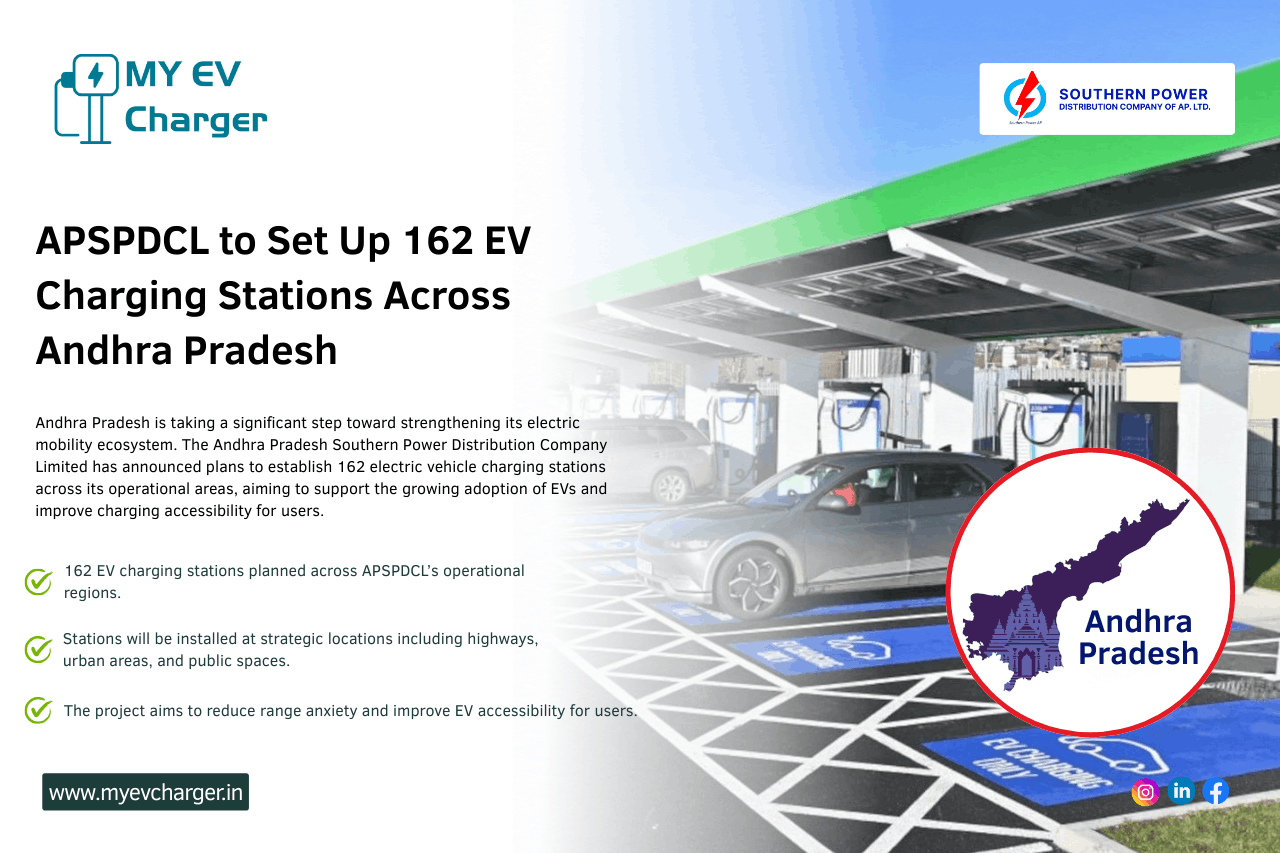
APSPDCL Plans to Set Up 162 EV Charging Stations, a move that could strengthen public charging access across Andhra Pradesh at a time when charging visibility remains one of the biggest barriers to EV adoption. Andhra Pradesh Southern Power Distribution Company Limited has proposed installing public charging stations at 162 locations across its service area, with each site equipped with 13 kW light EV AC/DC chargers under the PM E-Drive initiative.
According to the report, the plan is part of a wider clean-energy and grid-modernisation roadmap being pursued by APSPDCL. The utility has linked the charging-station rollout to the state’s clean-mobility push and its broader effort to reduce greenhouse-gas emissions while expanding environmentally sustainable electricity services.
What makes this story more interesting is that the charging announcement is not standing alone. APSPDCL has also outlined a larger transition plan that includes adding 550 MW of solar capacity annually from 2026-27 to 2029-30, taking the cumulative target to 2,200 MW under PM-KUSUM 2.0. In parallel, the discom said a 500 MW / 1,000 MWh battery energy storage system is being implemented in the first phase.
The wider clean-energy agenda extends beyond utility-scale targets. The report notes that the state is advancing green-energy deployment in Kuppam, which is being developed as India’s first net-zero model constituency. It also mentions 4.36 MW of solar capacity for 7,489 SC and ST consumers, 39.75 MW of rooftop solar covering more than 48,000 households, and a separate 50 MW / 100 MWh BESS project under the programme.
From an All India EV lens, this is more than a state utility announcement. It shows how EV charging is increasingly being folded into a broader electricity-system strategy involving distribution reform, renewable integration, storage, and local decarbonisation. When utilities begin treating charging as part of infrastructure planning rather than as an isolated add-on, the EV market gets a sturdier foundation.
How This Will Help the Indian EV Market
This development matters because it tackles one of the most practical problems in India’s EV transition: public confidence in charging access. Many potential EV buyers, especially in smaller cities and non-metro regions, still hesitate because they are unsure where they will charge outside home or office. A plan to install 162 public charging stations directly addresses that trust gap.
More EV News

The second reason this matters is institutional. When a state distribution utility takes ownership of charging deployment, it changes the conversation. Charging stops looking like a niche private-sector experiment and starts looking like part of mainstream power infrastructure. That can improve long-term reliability, land coordination, grid readiness, and integration with local electricity planning.
There is also a systems benefit here. APSPDCL is pairing EV charging with solar expansion and battery storage, which is exactly the direction India’s energy transition needs. Public chargers alone do not create a durable EV ecosystem. But chargers backed by cleaner electricity, storage support, and utility-led planning can create a more resilient model for scale.
If more discoms across India follow a similar approach, the EV market could become less fragmented and more infrastructure-led. In plain terms, this is the kind of move that helps electric mobility feel less experimental and more normal.